Were Hammurabi's Code the First Ever Written Laws?
The King of Justice
1790 - 1750 BC, Iraq
“Look at this guy,” Jay’s uncle Ray said, pointing to a Mesopotamian king holding a tablet. “These here are the oldest written laws in the world. Amazing! They’re called the codified edicts of Hammurabi.”
You’ve probably read in school or heard somewhere that Hammurabi’s Code is the world’s first codified laws. That is, the first evidence of formally defined, written laws for a king’s subjects to follow.
But were they really the world’s first codified laws?
Let’s take a trip to the history of Mesopotamia because it’s an incredibly fascinating civilization and region. Knowing a little more about who else lived there and who came before Hammurabi is important to answer this question.
The Sumerians
It’s not without reason that Mesopotamia is called the cradle of civilization. We can start around 3500 BC, and until Hammurabi’s time, there were three major civilizations. The earliest were the Sumerians, a brilliant and fascinating people who invented the cuneiform writing system, the 360-day year, agricultural methods, wrote the famous Epic of Gilgamesh, and are the origin of many interesting gods and goddesses.
Soon after, around 2350 BC, the Akkadians emerged, and the famous Sargon of Akkad was one of them. The Sumerians and Akkadians lived intertwined lives — they were separate for a while, then the Akkadians defeated the Sumerians and took power, and then the Sumerians came back. Then the Elamites (from what is now Iran) came and defeated the Sumerians, and the Amorite dynasty rose soon after in Babylon.
Why does all that matter? Because Hammurabi didn’t just show up and do something spectacular. He rose in a region with already illustrious and brilliant people who had contributed much to further human knowledge, including the terrific invention of writing, which the Akkadians and the Amorites (Hammurabi was one) borrowed from the Sumerians.
Now that we’ve established that he was part of and benefited from a rich ecosystem, let’s learn a little bit about Hammurabi’s laws.
What Did the Code of Hammurabi Say?
In 1901, French archaeologists in Susa (in modern Iran) found a stele. It was probably erected after Hammurabi’s conquest of Susa or brought there through plunder sometime later. Anyway, the stele is probably one of the most valuable and fascinating glimpses into that ancient world. The stele is about 7 and 1/2 feet tall, made of basalt, and on it, 282 laws are inscribed.
The laws can be generally categorized into property, family, labor, trade, justice and retribution, civil, and criminal law. Unlike modern laws that run hundreds and thousands of pages of snooze-inducing formal text, the Hammurabi Code is pretty straightforward and simple. It’s mostly single sentences with “if…then.”
Here are some examples:
If a cow doctor or a sheep doctor has treated a cow or a sheep for a severe wound and cured it, the owner of the cow or sheep shall give one-sixth of a shekel of silver to the doctor as his fee.
If that slave will not name his owner, he shall drive him to the palace, and one shall inquire into his past and cause him to return to his owner.
If a man has stolen an ox, sheep, ass, pig, or ship, whether from the temple or the palace, he shall pay thirtyfold. If he is a poor man, he shall render tenfold. If the thief has naught to pay, he shall be put to death.
Here’s an “interesting” one:
If a tavern-keeper does not accept corn at gross weight in payment for a drink but takes money, and the price of the drink is less than that of the corn, she shall be convicted and thrown into the water.
I guess being a bartender in those days was a pretty risky business!
There are many “put to death” clauses in the code, but we’ll discuss that later.
The 282 laws cover a gamut of topics and provide a great glimpse into life in those days. What was special about Hammurabi’s laws was not so much that there were laws (other civilizations did, too), but that he realized the best way to have people follow them consistently — based on his words, not on a regional governor’s or judge’s mood — was to have them inscribed and sent around.
We emphasize Hammurabi’s Code because he really had the laws codified and communicated. Archaeologists have found multiple copies and fragments all around Iraq, suggesting it was widely disseminated and possibly even taught in schools. We even have evidence of its roots in kingdoms nearly a thousand years after Hammurabi, which really speaks to its impact.
For the poor and the oppressed, this must have been truly a boon. Local tyrants couldn’t do whatever they wanted (at least not easily) because the king’s word was there—right there—written! When petitioners came before judges, they now had a basis to argue and set penalties and punishments, and it wasn’t at the whim of whoever sat on the judgment chair.
But this isn’t about praising Hammurabi’s Code’s awesomeness but to answer the question, “Were they the first codified laws?”
And we’ll answer that through evidence.
The Code That Came Before
Remember we talked about the Sumerians? That civilization was gone by Hammurabi’s time. Around 2000 BC, the king of Sumer, Ibbi-Sin, struggled mightily. He dealt with a change in the course of the Euphrates River, constant attacks on his borders from roaming nomads and foreign adversaries. It all came to a head when Kindattu, the king of Elam, attacked Ur (the Sumerian king’s city at that time, in Iraq) and defeated Ibbi-Sin. He was taken away to Elam and probably died there, and with that, Sumerian rule finally came to an end forever. Okay, not entirely, because there was a later dynasty that ruled for a century or so, called the Isin dynasty, but for all intents and purposes, it’s fine to treat Ibbi-Sin as the last Sumerian king.
But the Sumerians, while gone, had a lasting impact on all subsequent kingdoms in the area. They not only left a rich legacy of agriculture, beliefs, administrative methods, and science but also writing. Previous and subsequent kings borrowed much from Sumerian practices, including adapting the Sumerian script, which, over time, was subsumed into Akkadian — which became pretty much the lingua franca of the entire Middle East within centuries.
In fact, in the 6th century BC (almost 1,400 years after the end of Sumer), students at Assyrian King Assurbanipal’s schools were still translating ancient Sumerian tablets into Akkadian. (I know, I know — Sumerians, Akkadians, Assyrians, Elamites… sigh. Here’s a quick guide: Sumerians were in today’s southern Iraq; Akkadians in the center; Assyrians in the north; and Elamites were from modern Iran, further southeast.)
So, Hammurabi, as king of Babylon, would have had a rich copse of literary material and administrative practices from his illustrious predecessors. While we can’t prove one way or the other that he specifically borrowed anything, it’s not a stretch to imagine he was influenced. Now, was that influence just generic? As in, “I heard three hundred years ago such-and-such did this, so I should do something too,” or was there anything more specific?
We’re in luck. There was a precedent.
Let’s return to the Sumerians. The last king, Ibbi-Sin, was the final one in what is called the Ur-III dynasty, all from the city of Ur. The first king was called Ur-Nammu, and he defeated the Akkadians to bring the Sumerians back to power. Ur-Nammu was a successful king who ruled sometime around 2100 BC.
His success wasn’t just about his rule and administrative achievements. You see, Ur-Nammu also defined laws. That’s right. The laws of Ur-Nammu, written and circulated on sun-burnt clay, predate Hammurabi’s by nearly 400 years.
We don’t have a full list of Ur-Nammu’s laws on a stele, but we have an idea of what they were about from the fragments. The thirty or so laws generally covered property, crime, family, and trade transactions, thus providing a framework and basis for future adaptations. They are gentler and kinder than Hammurabi’s, which again demonstrates the sophistication of Sumerian culture. Outside capital punishments, the Ur-Nammu Code focuses on penalties rather than bodily harm.
Here is an example of Ur-Nammu’s code and how Hammurabi dealt with it later.
Ur-Nammu: If a man knocks out the eye of another, then he shall pay half a mina of silver.
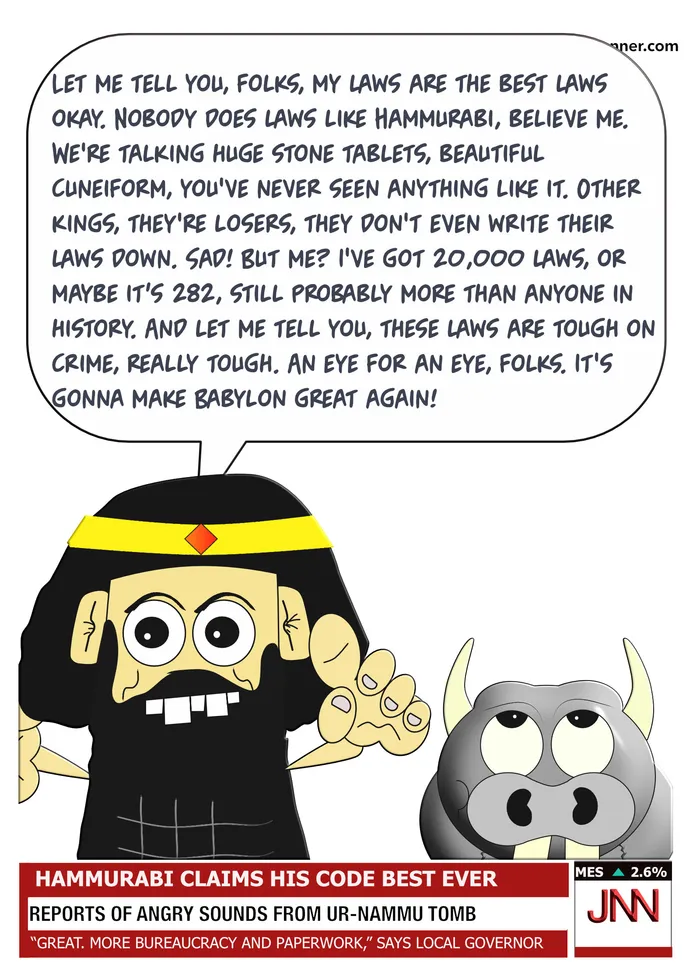
Hammurabi: If a man puts out the eye of another, then his own eye shall be put out. Remember “an eye for an eye”? This is where it originates!
Scholars believe that Ur-Nammu may not have dictated all of the code, and that his son Shulgi may have had a hand in it. Whatever the case, they are known as the Ur-Nammu Code.
So, why were Hammurabi’s codes harsher?
The theory is that during Ur-Nammu’s time, the population was more or less homogenous, and people generally understood the framework of law and administration and maybe followed it. But by Hammurabi’s time, the population had become more diverse and possibly more troublesome, causing the king to impose much harsher punishments. Or it could be that Hammurabi was just grumpier.
Were Ur-Nammu’s laws the only ones between them and Hammurabi? Not quite! We are aware of other written laws, like that of Lipit-Ishtar. The point is, Hammurabi’s Code emerged as an evolution rather than appearing out of nowhere and never having been done before. Where he went further was in the extent of the laws and how they were codified and sent to the various corners of the empire to establish the standard. For that reason, his laws have gained far more prominence, and rightfully so.
But to answer the question of whether he was the first to codify laws? Not quite.
Thank the Sumerians.
To buy this in book format: here | For sources and acknowledgments see here.






Whispers of Atlantis ● Book 6 of 7 ● Also in paperback
Lost cities. Buried armies. Ancient secrets. Seven thrilling tales where fact meets fiction.
The Death Pit ★★★★★
The House is Empty. The Wife is Missing. Now Someone Wants Him Dead. What should a scribe who has never held a weapon do?
Returning home to find his pregnant wife vanished, royal scribe Nemur is cast into a diabolical conspiracy where a man of reed pens and clay tablets must confront terrifying forces to uncover the truth and save the kingdom.




























About the Author
Jay Penner's highly-rated books regularly feature Amazon's category bestseller lists. Try his Spartacus, Cleopatra, Whispers of Atlantis, Hannibal or Dark Shadows books.