Was the Famous Queen Nefertiti Foreign Born?
The mystery of the beautiful queen
1353 - 1336 BC, Egypt
“Oh my God, she was so beautiful!” sighed Jay’s cousin Clay, staring at the magnificent plaster bust of the famous Egyptian Queen Nefertiti. “Did you know she was a foreign princess who came to Egypt?”
Was she foreign born, though?
Before we dive into that story, we should first learn a little about who she is and her world. Shall we?
Nefertiti’s story unfolds during the “Amarna” period (1353 - 1336 BC), a part of Egypt’s illustrious 18th dynasty, which began around 1550 BC with Pharaoh Ahmose.
In 1386 BC, a powerful Pharaoh named Amenhotep III ruled Egypt. When he died, his son Amenhotep IV took power. Amenhotep IV, who later called himself Akhenaten, was probably in his late teens or early twenties when he ascended the throne.
He married Nefertiti and began shifting Egypt’s religious focus from the principal god Amun to the sun god Aten. By the fifth year of his reign, he likely started constructing Akhetaten, his capital, now known as Amarna. In his twelfth regnal year, a grand celebration in Amarna, attended by dignitaries from far and wide, made it clear that the royal family had firmly established itself in the new capital.
Akhenaten died around his seventeenth year of rule. We don’t know how or when exactly, and his death created considerable chaos. He fathered six daughters, that we know of, with Nefertiti, with three of the six possibly having passed away by the twelfth or thirteenth year of his reign. He had no son with Nefertiti, but he did have one with a lesser wife, and that son was the famous Tutankhamun. Actually, Tutankhamun was called Tutankhaten at birth, and he changed his name after his father’s death, but that’s a different story.
But what does all this have to do with her being a foreign-born princess? Wait, we’ll get there.
Since we’re going to read a few names repeatedly, here’s a quick visual recap to help make sense of the rest of the chapter.
- Amenhotep (Amenhotep III) - the dad, a powerful Pharaoh of the 18th dynasty.
- Akhenaten - Nefertiti’s husband and Amenhotep’s son.
- Nefertiti - the Queen, daughter-in-law, and Great Royal Wife of Akhenaten.
Akhenaten and Nefertiti
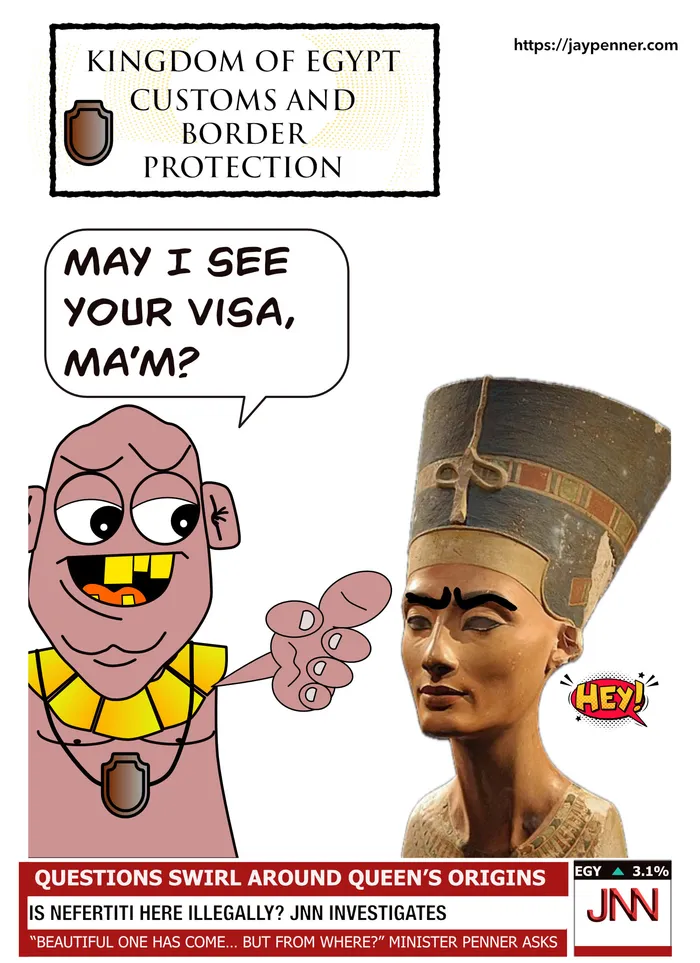
We have no historical records of Nefertiti’s marriage to Akhenaten, except that we know she was his Great Royal Wife (that’s the title ancient Egyptians gave to the most important wives of a Pharaoh), and she has been depicted very prominently throughout his rule. They didn’t say anywhere, “Akhenaten met Nefertiti during his foreign jaunt, and she landed here on a visa,” or anything like that. So why are people claiming she was foreign-born?
It’s because of her name. You see, the translation for “Nefertiti” means “the beautiful one has come” or “the beautiful one has arrived.” Nefer was a common word in ancient Egyptian, and it stood for beauty. In fact, it was so common in the family that two of Nefertiti’s daughters had the word “Nefer” in their names: Meritaten, Meketaten, Ankhesenpaaten, Neferneferuaten-Tasherit (“Little Nefertiti,” as Nefertiti was also known as Neferneferuaten), Neferneferure, and Setepenre. It is worth noting that Ankhesenpaaten, the third daughter, would later become the wife of Tutankhamun and rename herself as Ankhesenamun (just as Tutankhaten became Tutankhamun, ridding himself of the Aten suffix and returning to the old gods).
Yes, that famous Tutankhamun was Nefertiti’s stepson, famous because we found his magnificent intact tomb, not because he did anything amazing. I digress.
Let’s return to the meaning of the name “Nefertiti.”
Since the name meant “the beautiful one has come,” some began theorizing that “has come” suggested she must have come from somewhere, and that somewhere probably was outside Egypt. Before we question that rather tenuous extrapolation, could there be a kernel of truth? Did the Pharaohs marry foreign princesses? Maybe people put two and two together?
The Pharaohs and the Mitanni
It seems the Pharaohs did indeed marry foreigners, which is why this theory has some credibility. We discussed Amenhotep III, Akhenaten’s father, and Nefertiti’s father-in-law. Amenhotep was a powerful Pharaoh, and his fame was well known even in the far kingdoms that comprise modern Syria, Lebanon, and even as far as Iraq. Kings from there regularly corresponded with Amenhotep, and one of the kingdoms in frequent touch was an empire called Mitanni.
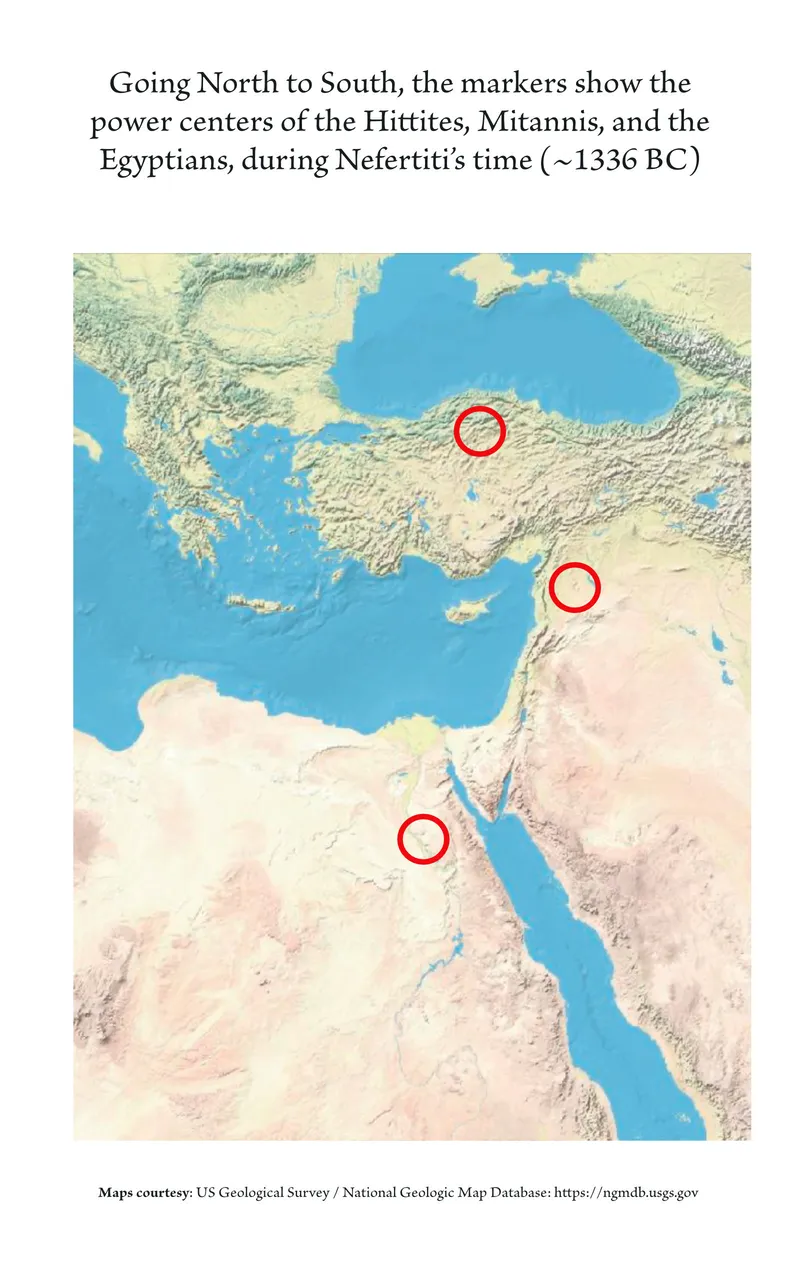
So, Egypt and Mitanni became close allies, partly because the Mitanni were threatened by a rising power in what is today Turkey—the Hittites. The Mitanni sought Egypt’s support to counter this threat. To solidify this alliance, the king of Mitanni, Shuttarna II, married his daughter Gilukhipa (or Giluhepa, depending on who’s writing the name) to Amenhotep. This demonstrates that the family had precedence in marrying foreign princesses. But wait, there’s more!
Amenhotep did not stop there. He later married another Mitanni princess named Tadukhipa (or Taduhepa), who was a daughter of Shuttarna’s successor, Tushratta.
Now, could that mean Amenhotep’s son married a foreign princess?
Maybe, but it’s unlikely. Here’s why: Amenhotep’s Great Royal Wife was a woman named Tiye, and she was very Egyptian. The women brought through alliances rarely reached the top rank, which usually went to native-born women.
Precedence to Royal Wives being Foreign
In fact, even if we go a thousand years before Nefertiti’s time, there are only a handful of known cases of foreign princesses marrying Egyptian Pharaohs. Over the thousand years that followed, only a few cases exist again. Of those, almost no one became a “Great Royal Wife.” Let’s think about that again: in nearly two thousand years of Egyptian Pharaonic rule, there were probably only a handful of foreign-born principal royal wives.
There’s something else to consider regarding the necessity of bringing in a foreign wife as an alliance—was there a dire need? The fact is, Amenhotep had already cemented strong relations with the Mitanni, as evidenced by a fascinating set of letters called the “Amarna letters.”
Amenhotep ruled a strong and vibrant Egypt. Now, could the father have pressured his son into marrying a foreign princess as his first wife as an alliance despite already having two of his own? Nothing dangerous was happening in Egypt’s borders at this time, so there was no known crisis. Moreover, all evidence suggests Nefertiti married Akhenaten very early in his reign, probably even before.
These two reasons — (a) there wasn’t a desperate need for an alliance and (b) she entered his life very early — are already compelling enough to counter the idea that his principal first wife was foreign. Not only that, Akhenaten simply wasn’t a great diplomat. He kind of ignored his neighbors, didn’t pay much attention to their frustrations, and we have evidence of this in the Amarna letters, with governors begging the Pharaoh to address their grievances.
Here’s a short example of “Atakamma of Qadesh” complaining to Akhenaten.
To the king, my lord: Message of Etakkama, your servant. I fall at the feet of my lord, my Sun, seven plus seven times. The wicked Biryawaza is defaming me in your sight, and […] then he took my entire paternal estate along with the land of Qidu and set fire to my cities…
Another point to note is that none of the preserved Amarna letters suggest in any manner that Nefertiti could have been foreign.
Anyway, given Akhenaten was very preoccupied with his “let’s get rid of all the old gods (Amun and co.) and get a bright new one (Aten)” agenda, it’s unlikely he sought to cement a new alliance by marrying a foreign princess early or later in his reign.
Egyptian royalty strongly favored “their own stock.” In fact, they favored it so much that many Pharaohs married their own sisters (yes, eww, but a very common practice then), and in rare cases, daughters too (though many scholars think that might have been ceremonial).
However, it was not uncommon for royal wives to come from non-royal origins. Scholars believe Nefertiti had commoner origins — possibly the daughter of Ay, a senior advisor to Akhenaten who eventually became Pharaoh for a few years. But we don’t really know for sure.
Given there is absolutely no archaeological evidence indicating Nefertiti was foreign-born, and that she was the Great Royal Wife from very early in the marriage, it is very unlikely she came from anywhere else but Egypt.
BUT WHAT ABOUT THE NAME?! (clenching fists)
But… but… what about the name?
While Nefertiti wasn’t an especially common name among royals, Nefer was a common word. Nefertiti might have simply meant “the beautiful one has arrived” — as in, arrived on this earth from her mother’s womb. A beautiful baby has arrived; it’s such a natural name.
If we accept the “foreign” interpretation, many Egyptian babies might have lost their statehood. It’s also possible that later queens didn’t take that name because later Pharaohs greatly despised the Amarna dynasty due to Akhenaten’s shenanigans — they hated them so much that they tried to erase all records of Akhenaten and Nefertiti, which may be why families avoided that name too.
So, that’s the story of Nefertiti and her name.
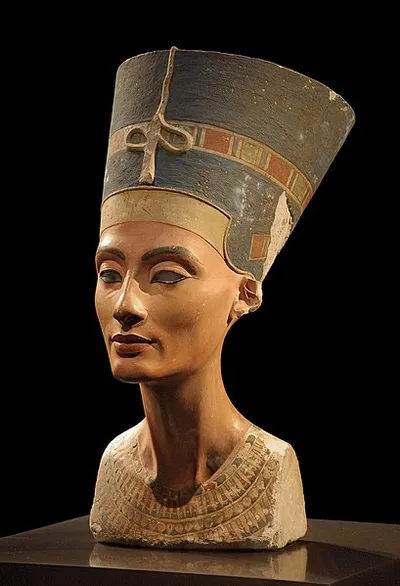
And here she is, in all her glory, as created by the sculptor Thutmose in his workshop in Amarna. It’s probably the most famous ancient bust in all the world, and deservedly so.
Source: Wikimedia Commons
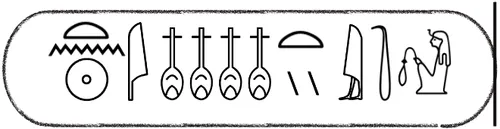
By the way, here’s something cool: the image below is the cartouche of Nefertiti—that is, the ancient Egyptian symbol that represented her name in hieroglyphics.
It goes “nfr-nfrw-itn nfrt-iy-ti,” that is, “Neferneferuaten Nefertiti” or “Most Beautiful of the Aten, the Beautiful one has come.”
Beautiful, right?
To buy this in book format: here | For sources and acknowledgments see here.






Whispers of Atlantis ● Book 7 of 7 ● Also in paperback
Lost cities. Buried armies. Ancient secrets. Seven thrilling tales where fact meets fiction.
The Crimson Aten ★★★★★
Thief or the Savior of a Dying Kingdom?
Hapu the thief's greatest heist is about to thrust him into a viper's nest where, bewitched by a princess and pursued by a murderer, he must navigate an insidious conspiracy to shield the Queen from those who would drown Egypt in blood. First time visitor? This novel is a fantastic way to get introduced to the anthology!






























About the Author
Jay Penner's highly-rated books regularly feature Amazon's category bestseller lists. Try his Spartacus, Cleopatra, Whispers of Atlantis, Hannibal or Dark Shadows books.