Did the Trojan War Really Occur?
Maybe someone was horsing around
~1200 BC, Turkey
“The Greeks did a number on the Trojans for stealing their lady,” Jay cackled. “But this whole Trojan Horse thing is sheer genius!”
The Trojan War and the story of the Trojan Horse are widely known and immensely popular. Some may have even seen the entertaining movie Troy, starring Brad Pitt as Achilles, Eric Bana as Hector, and Brian Cox as the menacing Agamemnon. But did the war really happen? Is Troy even a real place? And did the Greeks really use a giant wooden horse to enter Troy?
Let’s do what we do: go to the earliest sources that mention the war, the horse, understand the timelines, and look at what modern evidence says.
The earliest record of the Trojan War comes from Homer’s famous works, the Iliad and Odyssey. But first, a little about Homer. One of the most influential poets in Western literature, he is said to have lived in the 8th or 7th century BC in Greece. We don’t really know where he was born or lived because multiple cities claim him to be their son.
Given that he lived so long ago (about 300 years before Herodotus and 2,800 years before us), it’s also unclear whether he was a single person or a collective name for multiple poets writing about similar themes. Crucially, the major events in Homer’s poems relate to a world that was already 400 to 500 years old to him — think of a contemporary poet writing about events that happened in 1500 AD, relying almost entirely on oral records. Homer wasn’t a historian; he was a poet. For this reason, the Iliad and Odyssey are considered tales, with echoes of reality embedded in them.
The brief summary of the Trojan War, as described by Homer, is this: The Greeks (technically the Mycenaeans, or proto-Greeks, whom Homer calls Achaeans) are enraged when Paris, a Trojan prince, abducts Helen, Menelaus’s wife. Menelaus is King Agamemnon’s brother. The furious Greeks sail to Troy and launch a ten-year war, with Achilles, their most famous warrior, going up against Hector of the Trojans. Eventually, the Trojans lose, and according to Homer’s version, Helen returns to Sparta with Menelaus and lives out her days peacefully. There are other variations of the Helen story, but that’s for another day.
So, did the Trojan War really occur, or was it all just a story? The tricky thing about this subject is figuring out which parts might be true and finding evidence for those things. Timing the events based on Homer places the war around 1300–1200 BC — around the time Pharaoh Akhenaten and Nefertiti ruled in Egypt, or later during the reign of the Ramesses. Literary records from this era are exceedingly scarce.
Written Contemporary Records of the Trojan War
Mycenaean interactions with Egyptians or Mesopotamians were rare, so we have no records about this war in Egyptian or cuneiform texts. Some intriguing references exist from Hittite sources — not regarding the war specifically, but about peoples in the geographies Homer describes. The city was probably called Wilusa by the Hittites, aligning with Homer’s Greek “Ilios,” another name for Troy. There are also tantalizing snippets from Hittite correspondence that allude to conflicts between the people of Wilusa and the Ahiyyawa, likely referring to Homer’s ‘Achaea.’ But these references are too scant to make meaningful determinations.
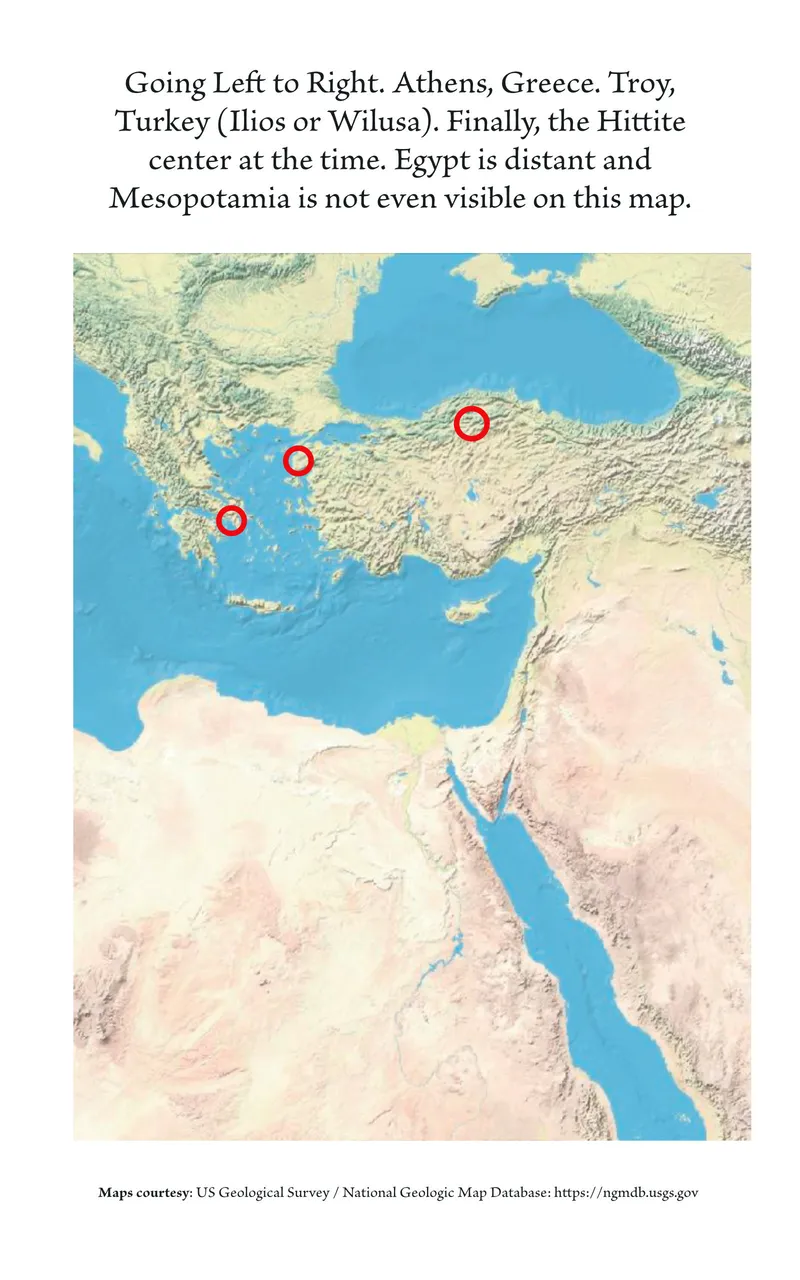
What are we left with, then, except stories and a few scant mentions?
One angle of research involves the search for Troy. Homer mentioned the city extensively and alluded to its location through contextual references. For example, he indicated that it was near the Hellespont (near modern Dardanelles), in sight of Mount Ida, and near the rivers Scamander and Simois. Ancient writers rarely provided detailed directions.
The Search for Troy
While people have speculated about its location since antiquity and even visited a place called Troad in Turkey thinking it was Troy, it was in 1822 that British businessman and traveler Frank Calvert proposed that the ancient ruins of Hisarlik in modern-day Turkey could be the actual site of Troy. Calvert’s theory emerged from using Homer’s hints about the location alongside the discovery of some Greek coins that mentioned “Ilium.” A significant breakthrough occurred in 1868 when wealthy German amateur archaeologist Heinrich Schliemann visited the proposed Hisarlik site after reading about Calvert’s theory. He became convinced it was the site of Troy.
So, Schliemann began excavations in 1870. His methods weren’t as meticulous and methodical as modern archaeology. He “brute-forced” his way through the hill, digging trenches, and searching for treasures and anything else he could find.
But Schliemann struck gold—literally.
He uncovered the ruins of several ancient cities built one on top of the other. In 1873, he discovered caches of gold jewelry and ancient artifacts that he labeled “Priam’s Treasure” after the legendary king of Troy from the Iliad. This guy even had his wife wear the jewels for photographs!
To be clear, nothing suggests these were Priam’s treasures (he was the king of Troy at the time of the war), but the treasures likely belonged to the people who lived possibly even a thousand years before the Trojan War. Nevertheless, the discoveries were sensational and sparked genuine interest in the study of this city.
Over the next century, including now, further excavations have revealed a series of cities (numbered I to IX, with IX being the latest) built on top of each other, with Troy VIIb as a potential candidate for the time of the Trojan War. Again, whether that layer specifically represents the city of the Trojan War cannot be asserted with high certainty because the archaeological evidence is flimsy.
It’s possible Homer amalgamated multiple events from a distant past into a single narrative. What we know from the excavations is that this was a sizeable (for the time, with about 10,000 to 20,000 inhabitants during the Bronze Age; making it significantly important) continuously inhabited town/city from about 3000 BC, reaching its zenith probably around 1200 BC before slowly falling into ruins after 1150 BC.
Whether its abandonment resulted from the war or something else (during this time, many ancient civilizations fell, but that’s another topic) is unknown. However, when Homer visited Troy, he must have seen the ruins. It appears that Homer’s story turned Troy into a pilgrimage of sorts, not too unlike how tourists flock to the “King’s Landing” of Game of Thrones, which is actually the Old Town of Dubrovnik in Croatia. It is said that even Alexander and later Roman emperors visited the site to pay homage to heroes like Achilles. There may have even been a Byzantine presence sometime in the 12th or 13th century AD, but overall, Troy never fully recovered from whenever it was mostly abandoned.
So, that’s the story of Troy. We’re fairly certain we’ve found its ruins. But we can’t say with equal certainty which layer definitively represents the time of the Trojan War, or if the war was even a significant enough event contributing to its downfall, or if it was significant enough to be just one of those local or regional skirmishes. We can, of course, create some sensational posts with AI images about glorious Troy, but that’s not what we’re about!
The Trojan Horse
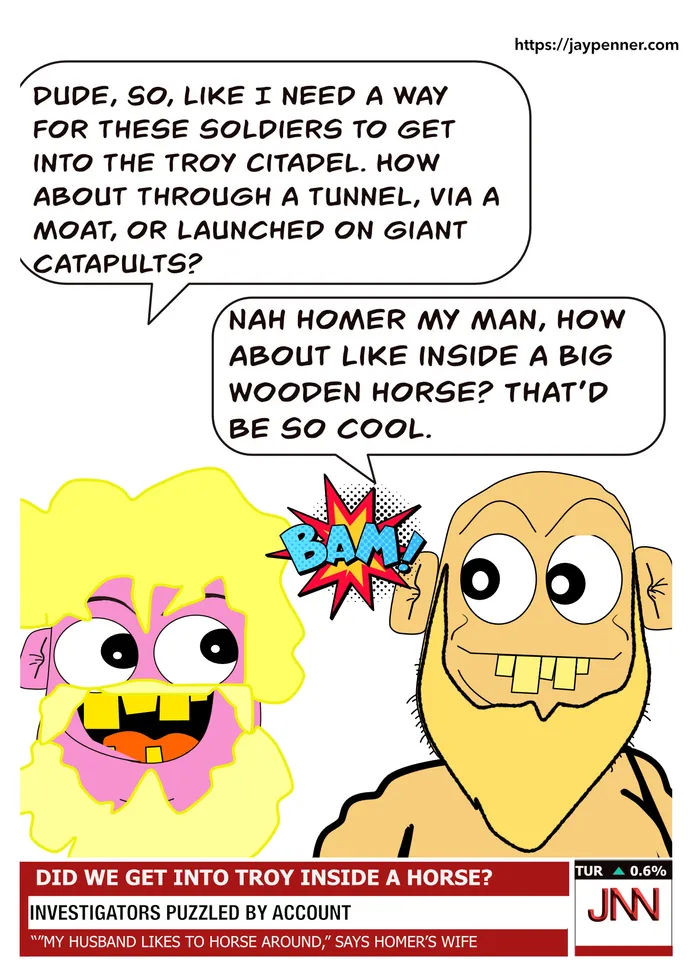
Now let’s get into the Trojan Horse. The story goes that the Greeks left a wooden horse with warriors hidden inside, pretending to abandon their ten-year war. The curious Trojans pulled it inside the citadel and, apparently continuing their night of drunken revelry, allowed the soldiers to emerge and open the gates, etc., etc.
Homer says very little about this incident, which he briefly alludes to in Odyssey.
Here’s an extract from Perseus: https://www.perseus.tufts.edu/hopper/text?doc=Perseus:text:1999.01.0136:book=8:card=469 under Creative Commons License.
But come now, change thy theme, and sing of the building of the horse of wood, which Epeius made with Athena’s help, the horse which once Odysseus led up into the citadel as a thing of guile, when he had filled it with the men who sacked Ilios.
That’s all. Homer says nothing more.
The more detailed account actually comes from Virgil’s Aenead Volume II:
By destiny compell’d, and in despair,
The Greeks grew weary of the tedious war,
And by Minerva’s aid a fabric rear’d,
Which like a steed of monstrous height appear’d:
The sides were plank’d with pine; they feign’d it made
For their return, and this the vow they paid.
Thus they pretend, but in the hollow side
Selected numbers of their soldiers hide:
Virgil wrote this sometime between 29 and 19 BC, or about 800 years after Homer and over a thousand years after the Trojan war. Now, did he have other credible sources to the story of Trojan horse that we do not know, or did he make up the details as part of his poem, we cannot say. Some speculate that the Trojan horse actually alludes to military siege engines and not a literal horse, but then that’s not what either Home or Virgil say. They seem to be pretty clear that it was a horse and a thing of guile.
Anyway, there are so many plot holes here that I wouldn’t even know where to start. Knowing this was a long-running ten-year war, how foolish must the Trojans have been to fall for the ruse? How could a few soldiers stuffed inside a wooden horse cause such havoc? How could the people who pulled it in not even hear anything?
Could there have been clever trickery that caused the Trojans to open the gates? Yes, it’s possible. Was it because of this horse or something else? We don’t know. The horse could be real, an allegory, a mistranslation of military siege engines — or it could all be made up. Archaeologically, we’ve found absolutely no evidence of any kind, and no historical source other than Homer (or those drawing from Homer) mentions this conflict, let alone the horse.
The scholarly consensus is that this is most certainly a myth. But it makes for a cool story!
To buy this in book format: here | For sources and acknowledgments see here.
Whispers of Atlantis ● Book 5 of 7 ● Also in paperback
Lost cities. Buried armies. Ancient secrets. Seven thrilling tales where fact meets fiction.
The Curse of Ammon ★★★★★
Some Seek Glory. Some Riches. But One Seeks Revenge.
When the insolent priests of Ammon refuse to recognize him as Pharaoh, the enraged Persian emperor Cambyses dispatches fifty thousand men to burn their revered temple. Some plot for riches, some plot for glory—but all are about to find that the swirling sands of the desert are not the only thing in their path to plunder.
























About the Author
Jay Penner's highly-rated books regularly feature Amazon's category bestseller lists. Try his Spartacus, Cleopatra, Whispers of Atlantis, Hannibal or Dark Shadows books.