Did Spartacus' Men Say 'I Am Spartacus'?
Apparently some folks are dumb enough to invite crucifixion
73 - 71 BC, Italy
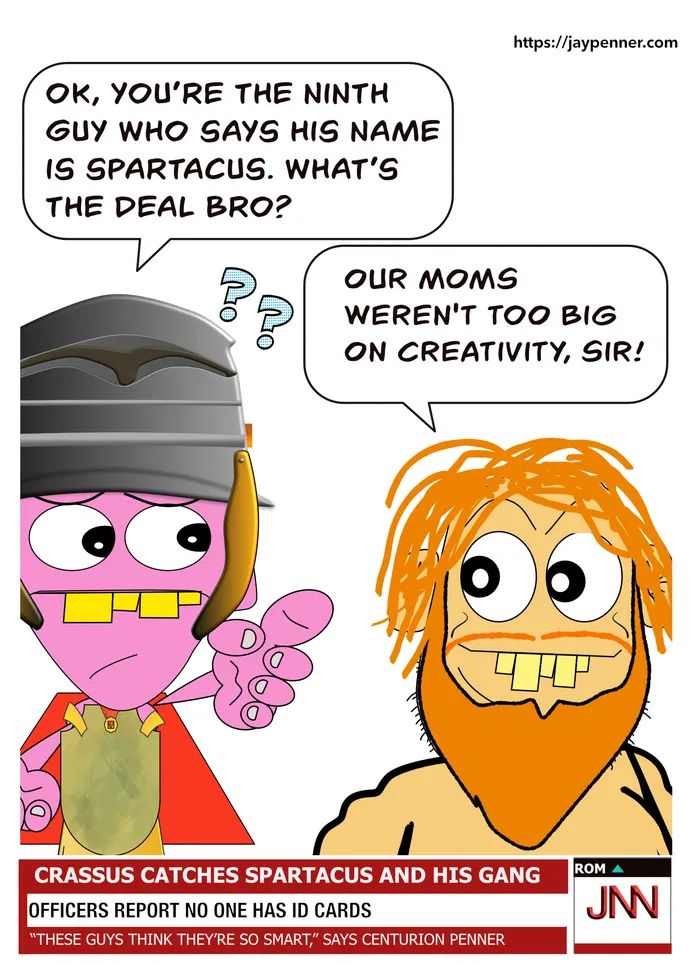
“Spartacus’ men all stood up and said ‘I am Spartacus’ to protect their leader!” Jay’s other cousin Tray exclaimed, repeating the famous scene from the movie. “Look at the younger generation. We’ve lost that honor these days!”
But did that really happen? What did Spartacus’ men actually do? Well, hello historical sources!
First, a little bit of history and context because that’s important if we want to understand what may have really happened.
Spartacus was a Thracian (modern Bulgaria) gladiator who led a major slave uprising against the Roman Republic — the event known as the Third Servile War, which lasted from 73 to 71 BC. He escaped from a gladiator school in Capua, Italy (near modern Naples), and gathered a large following of escaped slaves, other gladiators, and discontented peasants.
Spartacus and his men fought several battles against Roman forces, becoming a significant threat to Rome. He became famous not only for taking on the might of Rome but also for fighting them from the head to foot of Italy and winning several battles, including defeating Roman consuls, which was almost unthinkable. He was certainly a formidable leader and had a committed following willing to fight alongside him.
The famous scene where Spartacus’ men say “I am Spartacus” comes from Stanley Kubrick’s 1960 film Spartacus. In the movie, after Romans capture Spartacus, his men attempt to protect him by each claiming to be Spartacus, thus confusing the Romans. They didn’t have mugshots back then, so someone had to identify him. But did that happen, or were Spartacus fans getting a tad too share-excited again?
Historical Accounts of Spartacus
Our primary sources for the story of Spartacus come from ancient Roman historians, including Sallust, Plutarch, Appian, and Florus. The closest account of Spartacus is from Sallust, who lived during Spartacus’ time and wrote about the uprising decades later. Unfortunately, most of Sallust’s work has been lost, and only tantalizing fragments survive. But fear not; he seems to have been the source for later writers, as listed below.
Plutarch (46 AD - 120 AD): In his Life of Crassus, Plutarch describes the events of the Third Servile War. He details Spartacus’ escape, his victories over Roman forces, and his eventual defeat. However, Plutarch makes no mention of Spartacus’ men claiming to be him to protect his identity. In fact, this is what Plutarch says:
…When his horse was brought to him, he drew his sword and said that if he won the battle, he should have plenty of fine horses from the enemy, and if he was defeated, he should not want one; upon which he killed his horse, and then he made his way towards Crassus himself, through many men, inflicting many wounds; but he did not succeed in reaching Crassus, though he engaged with and killed two centurions. At last, after those about him had fled, he kept his ground, and, being surrounded by a great number, he fought till he was cut down.
Appian (95 AD - 165 AD): In his Civil Wars, Appian provides another account of the rebellion. He describes Spartacus as a capable and charismatic leader who united a diverse group of rebels. While Appian offers detailed descriptions of battles and strategies, he does not include the famous “I am Spartacus” scene. Rather, this is what Appian says:
Spartacus was wounded in the thigh with a spear and sank upon his knee, holding his shield in front of him and contending in this way against his assailants until he and the great mass of those with him were surrounded and slain. The Roman loss was about 1,000. The body of Spartacus was not found. A large number of his men fled from the battlefield to the mountains, and Crassus followed them thither.
Between Plutarch and Appian, it appears that Spartacus died in the battle, and he was probably never found (or rather, his body was never identified and very likely left to rot among the rest). If we consider these accounts, there would be no reason for the Romans to line up the captured and give them a chance to say “I am Spartacus.”
Now, you might ask how Plutarch (or Sallust) came to learn of these last moments, and yet Spartacus’ body was never found. Don’t ask such questions.
Florus (74 AD - 130 AD): Florus, in his Epitome of Roman History, also covers the Third Servile War. He portrays Spartacus as a formidable enemy of Rome but does not mention any collective declaration by Spartacus’ men to protect his identity. He only states that Spartacus and his men met a worthy death and admires Spartacus for having fought bravely in the front as a general.
As seen above, the three definitive sources of the account, all possibly drawing from Sallust and other closer works, are unanimous that Spartacus died in battle.
Where did those famous words come from?
The idea that Spartacus’ men stood up and declared “I am Spartacus” to protect him is a powerful and dramatic scene, but it is a creation of modern storytelling rather than a historical fact. The movie Spartacus, based on Howard Fast’s novel of the same name, dramatized many aspects of Spartacus’ story to create a compelling narrative. The scene where the men declare “I am Spartacus” is a fictional addition — we should treat it as symbolic, showing solidarity and sacrifice, not as fact.
Now, even if we assume that the ancient writers got it wrong and Spartacus somehow survived, could it be possible that the Romans would line up the slaves and give them a chance to bamboozle them?
Extremely unlikely.
The reality was much darker.
The reality of the situation
The Romans never saw the slaves as much of anything, not even human. They were property with no rights, and the very fact that they took up arms was seen as a great shame that had to be put down ruthlessly. There is no account that the Romans tried to find his body or negotiate with him—they just wanted him dead.
There’s more in support of this theory: in the final stages of the conflict between Roman general Marcus Crassus and Spartacus, Spartacus sent a missive proposing a negotiation, but Crassus shot it down (in the TV series Spartacus, we see the two meeting, but there is no historical support for this).
Here’s what Appian says:
On account of this vote Crassus tried in every way to come to an engagement with Spartacus so that Pompey might not reap the glory of the war. Spartacus himself, thinking to anticipate Pompey, invited Crassus to come to terms with him.
This was a clever ploy by Spartacus, that if he were to negotiate a treaty with Crassus, it would look as if Crassus was the one who put an end to the Rebellion rather than Pompey take the glory. But it didn’t quite work out. The Romans under Crassus had no intention of parleying with the leader of slaves. Contrary to our dramatic passions, the Romans would have seen it as beneath their stature and dignity to negotiate with men they didn’t even see as people. In the end, Spartacus and his men received no consideration.
And to add, Crassus was a mean guy. This was a nasty, nasty man. First, remember the word decimation? In modern definitions, it usually means “killing or destruction of a large group or species.” But in ancient Rome, it meant something terrible — picking one in ten and executing them.
When one of Crassus’s lieutenants disobeyed him and ran from battle, Crassus revived the punishment. He divided the fleeing units into ten and had them pick one victim by lots. Each of those men was clubbed to death by their peers. The whole idea was that his men would fear him more than they feared Spartacus. This is what Plutarch says in his “Parallel Lives” regarding Crassus.
Crassus received Mummius himself roughly, and, arming the soldiers again, he required of them security for their arms, that they would keep them; and five hundred, who had been the first to run and had shown most cowardice, he distributed into fifty decades, and out of each decade he took one man by lot and put him to death. Thus, he inflicted on the soldiers this ancient mode of punishment, which had long fallen into disuse; for disgrace also is added to the manner of death, and many things horrible and dreadful to see accompany the punishment in the presence of all the spectators. After inflicting this punishment, he made his men again face about and march against the enemy.
Crassus’s nastiness didn’t stop there. By Appian’s account, the surviving six thousand were crucified (though this is not mentioned by other ancient writers). So even if Spartacus was one among those captured, not identified but not already dead, he probably died on a cross.
A grim and terrible end to a heroic uprising.
If there’s any solace, Crassus didn’t have a good end. He invaded Parthia sometime in 54 BC (about fifteen years later). His campaign was a failure, and he was killed in a skirmish while attempting to negotiate with the Parthians, who then took his body. Some accounts state that the Parthians poured molten gold into his mouth to mock his greed.
Note: The Spartacus Rebellion was a truly remarkable event, spanning about three years and covering the length and breadth of Italy. You can visit https://jaypenner.com/maps to launch the flyby of the ‘Spartacus’ trilogy. While the maps are based on my novels on the subject, you will be able to “fly” via Google to many locations of the Rebellion!
To buy this in book format: here | For sources and acknowledgments see here.

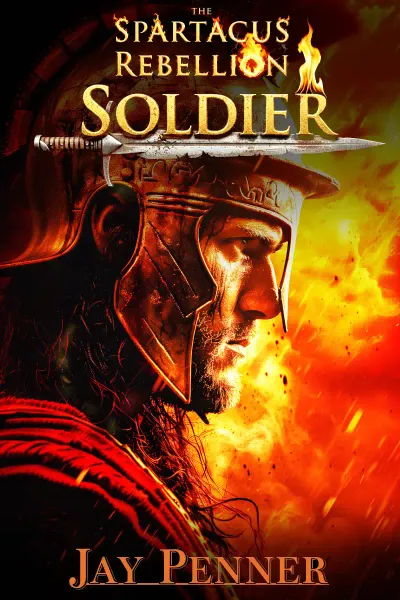
Spartacus ● Book 1 of 3 ● Also in paperback
Soldier. Slave. Legend. The astonishing tale of the man who shook Rome.
Soldier★★★★★
For Honor. For Vengeance. Or For Rome?
After a reckless raid brings savage retribution upon his tribe, young Spartacus joins a Roman auxiliary to douse the flames of shame—but a brutal march under a corrupt centurion sets him on a bloody path toward his fateful destiny.




















About the Author
Jay Penner's highly-rated books regularly feature Amazon's category bestseller lists. Try his Spartacus,Cleopatra,Whispers of Atlantis,Hannibal orDark Shadows books.