Did Julius Caesar Destroy the Library of Alexandria?
What kinda hooligan sets fire to a library?
48 BC, Alexandria, Egypt
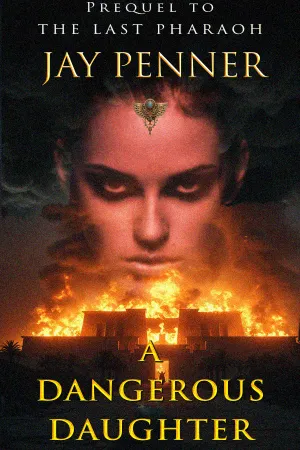
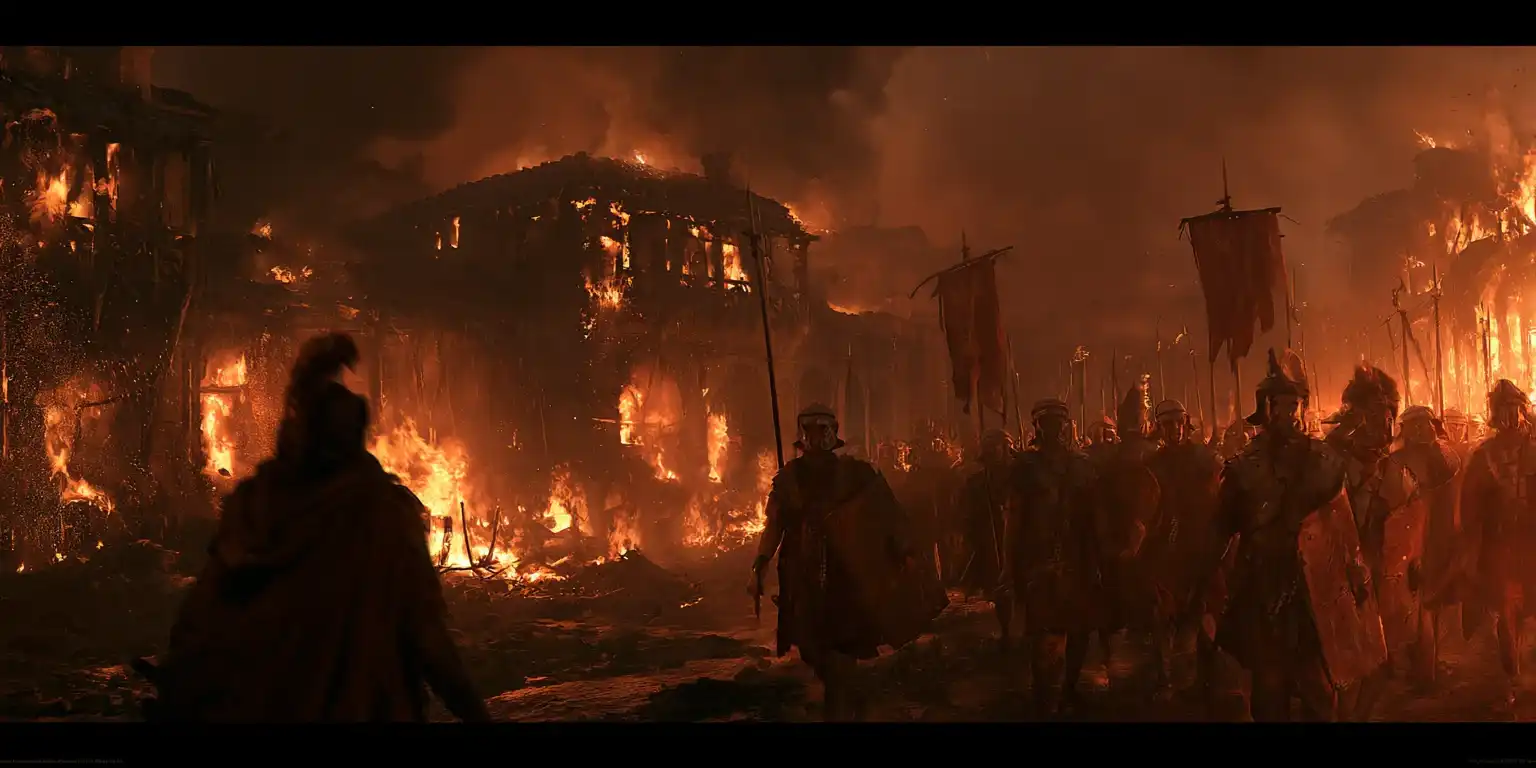
“Caesar burned the Library of Alexandria!” Jay’s cousin Clay declared fervently, fuming over a lovely AI-generated image showing a massive library in flames with Caesar laughing at his actions. “It is such a tragedy because the Library held all of ancient knowledge!”
This claim is popular, and there are two aspects to this story: one, that Julius Caesar burned it, and the second, that the great library was entirely destroyed, causing us to lose great troves of ancient knowledge. Before discussing its destruction, let’s examine some basic facts about the library.
First, let’s talk about Ptolemy, Alexander’s general, later Pharaoh of Egypt, and forefather of the famous Cleopatra. He was a bit of a scholar too and wrote extensively about his campaigns with Alexander, although we’ve lost all of it. Later historians like Arrian drew from his works.
Ptolemy probably began the initial plans for the library, but scholars believe it came to life in the 3rd century BC during the reign of Ptolemy II Philadelphus, the son of Ptolemy. It was part of the larger Mouseion (or institution of the Muses). The library aimed to gather all the world’s knowledge and housed a large number of scrolls and manuscripts (numbers vary). Ptolemy II was a patron of such endeavors, and the library likely flourished during his time.
As much as we talk about the great library, ancient sources don’t actually spend much time on it. We now need to test a couple of hypotheses to either prove or disprove that Caesar “destroyed” it, and that it held all the world’s knowledge that was suddenly lost.
How Caesar Ended Up in Alexandria
In 58 BC, Caesar went off to Gaul (mostly modern France and Belgium) and spent the next eight years conquering it. He wrote all about it in his “Conquest of Gaul,” which is the only account of a leading general that survives from antiquity. Trouble brewed in Rome while he was away, and eventually Caesar returned, “crossed the Rubicon,” and squared off against another leading Roman general and consul at the time, a man named Pompey Magnus. Caesar and Pompey finally faced off at Pharsalus in Greece, and Pompey lost.
Pompey ran away to Egypt, hoping that the young 12- to 13-year-old king there (Ptolemy XIII) would give him sanctuary. But the king, on advice from his regent, decided instead to assassinate Pompey, who was stabbed on a boat while trying to get ashore. The killers took Pompey’s head and kept it with them. Caesar, pursuing Pompey, landed in Alexandria soon after:
Caesar sailed to Alexandria’s shore,
Seeking Pompey, his rival of yore.
“Hand me Pompey!” was what he said,
But all he got was Pompey’s head.
Caesar was not happy at all. That, combined with the need to extract money from Egypt because they owed Rome a lot, made Caesar an unwelcome guest in Alexandria. But there was some other trouble brewing. Ptolemy XIII was fighting with his sister Cleopatra, yes, that same famous Cleopatra. Caesar took Cleopatra’s side, and all hell broke loose, eventually leading to a conflict known as the Alexandrian War, during which Caesar fought against Ptolemy’s forces. What does all this have to do with the library? Be patient!
Now, Caesar didn’t have an overwhelming force. He was actually severely outnumbered and surrounded, and he was trying to damage the Egyptian Navy. In one of the events, his men set fire to Egyptian ships in the dock by the palaces.
Let’s burn ’em Egyptian ships, Sire!
Light ’em up, set a pyre!
That’s right.
This dock was supposedly near where the Library of Alexandria stood.
The fire spread from the docks and burned some buildings, including the library.
Who says it? Plutarch, in his “Life of Caesar,” writing sometime in the 1st century AD, describes the event that occurred in 48 BC:
“Achillas, however, escaped to his camp and raised about Caesar a war grievous and difficult for one who was defending himself with so few followers against so large a city and army. In this war, to begin with, Caesar encountered the peril of being shut off from water, since the canals were dammed up by the enemy; in the second place, when the enemy tried to cut off his fleet, he was forced to repel the danger by using fire, and this spread from the dockyards and destroyed the great library; and thirdly, when a battle arose at Pharos, he sprang from the mole into a small boat and tried to go to the aid of his men in their struggle, but the Egyptians sailed up against him from every side, so that he threw himself into the sea and with great difficulty escaped by swimming.”
There, he states outright: “…and destroyed the great library.”
Much of the online speculation originates from Plutarch’s assertion that the library was destroyed.
That should settle this topic, right? Not quite. Keep in mind Plutarch wrote about a hundred fifty years or more after the event, drawing on older material — we don’t know which sources he used, so we can’t cross-check.
Do we have any sources closer to the time? Perhaps contemporary ones?
We do.
The only contemporary account of the Alexandrian War comes from a Roman author, possibly Hirtius, who was one of Caesar’s men. He describes the siege and the burning but makes no mention of damage to any library. Could he have omitted this dastardly act? Yes, he could have. Could Cleopatra have yelled at Caesar, and he replied, “Hirtius, keep this out of the records, dude”? Maybe. Or maybe it simply wasn’t noteworthy or significant enough to warrant mention. Anyway, Hirtius’s account doesn’t answer any questions one way or the other.
What next?
What the Subsequent Sources Say
Strabo was in Alexandria around the time of Cleopatra’s death, which was nearly twenty years after Caesar’s supposed burning of the library. He says this in his extensive work “Geographica,” while describing Alexandria:
“The Museum is a part of the palaces. It has a public walk and a place furnished with seats, and a large hall in which the men of learning who belong to the Museum take their common meal. This community possesses also property in common, and a priest, formerly appointed by the kings but at present by Caesar, presides over the Museum.”
This is an important passage that likely disproves Plutarch’s assertion, so let’s examine it closely.
First, “Museum” here is indeed a translation of “Mouseion,” which was essentially a place for “muses,” that is, a library. Strabo clearly states that the Museum is part of the palaces and appears to be intact (maybe restored?). How do we know that Strabo didn’t write this before it was destroyed? First of all, Strabo would have been a teen then. While he may have been a talented boy, he probably didn’t write Geography when he was at that age. Second, the critical part is that Strabo says, “…at present by Caesar.”
You see, the Caesar Strabo refers to here is Caesar Octavian, whom Julius Caesar nominated as his heir and who eventually became the first emperor of Rome. It was Caesar Octavian who, in 30 BC, defeated the combined forces of Antony and Cleopatra at Actium (modern Greece), marched to Alexandria, and was there when Cleopatra committed suicide. This event happened almost twenty years after Julius Caesar reportedly burned the Great Library. So, if Strabo visited Alexandria once Egypt became a Roman province and is describing the “Museum,” it appears the library was still there and not destroyed.
Strabo spent considerable time in Egypt, and as a writer and scholar, he surely would have admired the great library. One would think that if the burning had been such a major event, he would have lamented it. But he does not. In fact, he doesn’t say much more about the library at all. It also raises the question of whether by Strabo’s time, the library had lost its significance and that its glory had long passed.
What about later sources after Strabo? Writing sometime around 60 AD during Roman Emperor Nero’s time (almost a hundred ten years after the events), Lucan wrote this in his poem “Pharsalia”:
He ordered brands steeped in resin hurled at the sails
of the crowded ships, and the fire ran swiftly along
the rigging, over the decks whose caulking melted,
till the thwarts and the towering yards blazed as one.
Soon the half-burned vessels sank beneath the waves,
the attackers being swamped with their weapons.
Nor did flames fall only on the ships: houses nearby
caught fire with the fierce heat, and wind increased…
Lucan’s recollection states that “some houses caught fire.” Not quite a mention of the library.
We have a few more credible accounts. Seneca, in his work “On the Tranquility of the Mind,” writing sometime in the early 1st century, claims the Library of Alexandria was burned and lost 40,000 volumes.
Pliny the Elder, in his “Natural History,” says the library held 700,000 volumes.
Ammiamus Marcellinus, possibly the last Roman/Greek writer mentioning the library, in his History about four hundred years later, states that the fire consumed 700,000 volumes. It is entirely plausible that Ammiamus may have used Plutarch’s “destroyed” narrative and combined it with Pliny’s number of volumes.
Seneca, writing around 50 AD in his work “On the Tranquility of Mind,” states that forty thousand books were burned in Alexandria. He does not attribute this to Caesar, nor does he specify whether the 40,000 was the full extent or just partial damage. However, it is interesting that Seneca criticizes the library as being a showpiece for the wealth of kings rather than a center for learning.
If we accept the idea of a partial burning — combining Strabo and Plutarch — 40,000 out of 700,000 equals just 6%, meaning barely anything was destroyed. We also don’t know which of these numbers are accurate, and scholars believe the library may not have been a singular entity but a system with multiple locations in Alexandria. Numbers from ancient sources are often unreliable and exaggerated, but no one except Plutarch actually claims that the “entire library was destroyed.”
Some Arab writers, writing almost a thousand years after the events, describe it as being destroyed or diminished under various Roman emperors. But late accounts based on oral histories are hard to rely upon.
What about archaeological evidence? Unfortunately, we have none. We have never found either the precise location of the library or anything to suggest a burning. Ancient accounts rarely pinpoint a precise location; Strabo suggests it was attached to the palaces, which mostly sank beneath the sea or fell in earthquakes. In the two thousand years since, a modern city was built over it, and older structures are often destroyed or reused for building material.
Ultimately, based on the oldest sources, it seems reasonable to infer that some damage may have occurred to the library — but not to the extent portrayed. Caesar did not “destroy” the library in its entirety.
Was it the greatest library in the world?
And what about the story that the Library held all of mankind’s knowledge? Such statements are often made and shared widely, without much pushback or critical reasoning. How do we know it held “all of mankind’s knowledge”? On what basis? Compared to what? What about all the knowledge in other empires and kingdoms far away, such as in China, India, South American civilizations, Persia, and Mesopotamia? For example, around 1851 AD, British archeologists in Nineveh (Iraq) discovered the Library of Assurbanipal, a great Assyrian king who lived around 650 BC. This amazing discovery of nearly 30,000 cuneiform texts of the ancient Mesopotamian world is an example of an ancient library in another part of the world.
We might be able to say that the Library of Alexandria possibly contained a rich and outstanding collection, predominantly Greek. Whether that was the largest, the second largest, or the tenth is impossible to ascertain. What happened to the great library was likely a rather mundane matter: over time, it lost its value, fell into ruins without sufficient patronage, suffered damage in earthquakes and possibly looting and plunder, and slowly fell into disrepair before eventually vanishing from record. How it declined is a separate subject entirely. There is no question that we may have lost many compelling and exciting works from the ancient world, but there is little evidence to suggest it held all of the world’s knowledge or was destroyed in one deliberate act of stupidity.

To buy this in book format: here | For sources and acknowledgments see here.

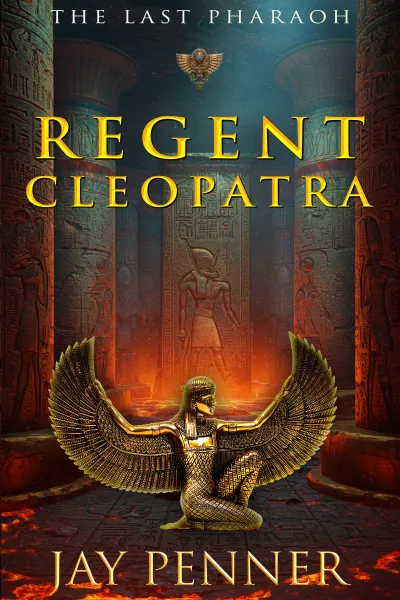
Cleopatra ● Book 1 of 4 ● Also in paperback
Regent at seventeen. Queen at twenty-one. Legend forever. The saga of Cleopatra.
Regent★★★★★
Some wells have poisoned waters.
Poised to take power at sixteen, Cleopatra inherits a kingdom teetering on civil war and a court thick with treachery, where a single misstep means death and the end of three thousand years of Pharaonic rule.

















About the Author
Jay Penner's highly-rated books regularly feature Amazon's category bestseller lists. Try his Spartacus,Cleopatra,Whispers of Atlantis,Hannibal orDark Shadows books.