Did Chandragupta Maurya Marry Seleucus' Daughter?
This marriage is making waves even after 2,000 years
297 BC, India
While we’re with the topic of Alexander, let’s explore another interesting topic.
“Did you know a famous Indian Emperor married a Greek General’s daughter, and his famous grandson was Indo-Greek?!” Jay exclaimed, turning his iPhone and pointing to a big yellow-text image of an exotic-looking Indian king with blue eyes. “See, it says right here!”
That’s a lot to unpack.
First, some context.
Which Indian Emperor? Which Greek General? Who is the “famous grandson”? Let’s familiarize ourselves with the broader context before jumping into this.
Back in 326 BC, Alexander the Great traveled all the way to India. About two years later, having abandoned the invasion, he returned to Babylon and died in 323 BC. After his death, his vast empire divided among many, leading to significant events in various parts of the world. His impact was immense. One of his generals, Seleucus Nicator, became the ruler of the Eastern provinces, from parts of modern Syria all the way to the Indus River and slightly beyond, under Alexander’s dominion.
Around the time Alexander came to India and left, the “king of India,” or rather the predominant ruler over major parts of Northern India, was a king named Dhana Nanda. Alexander and Nanda never fought because he was about a thousand miles away from Alexander’s last stop. However, soon after Alexander’s departure, a young man named Chandragupta Maurya overthrew the Nanda dynasty and took power in a city called Pataliputra, which is now modern Patna in the eastern Indian state of Bihar.
Why does this matter? Well, Chandragupta Maurya and Seleucus Nicator were contemporaries. The Mauryan Empire was a significant force; it expanded rapidly, reaching its zenith under his grandson Ashoka (Ashoka the Great), spanning from Afghanistan to the eastern borders of India and all the way to Southern India. Taken together, the geographical coverage of the Mauryan Empire was greater than the combined approximate size of modern Iraq, Iran, Syria, Jordan, Israel, Lebanon, Afghanistan, Greece, and Macedonia.
But we’re jumping ahead to Ashoka, so let’s come back to the early years of Mauryan rule.
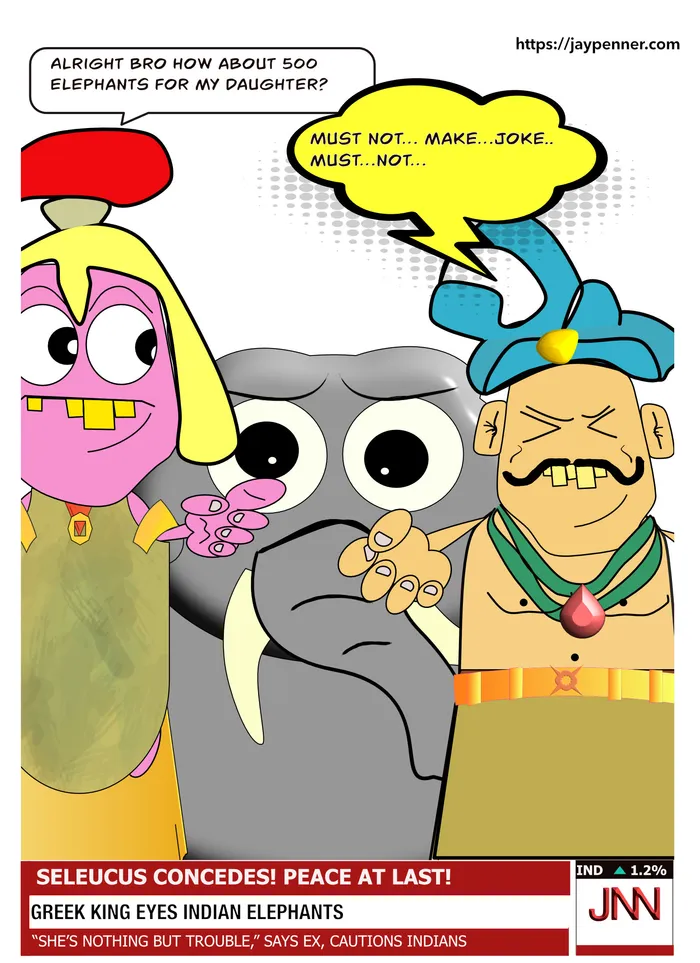
Seleucus, it seems, wasn’t too happy with all the vast provinces bequeathed to him after Alexander’s death because he wanted more. The story goes like this: Seleucus fought Chandragupta Maurya (called Sandrocottus by Greek sources), and in a settlement treaty, the Indian Emperor gave him five hundred elephants in exchange for Seleucus’ daughter (some even named her Helena) and receiving pretty much all of the previously conquered regions, including parts of modern Afghanistan. Basically, Seleucus got some elephants and Chandragupta got everything else.
So that’s where the tale of Chandragupta Maurya marrying a Greek princess comes from, along with the theory that his grandson Ashoka was of mixed birth.
Digging into the Evidence
How much of this is based on available ancient evidence, and what do we know about this first Mauryan emperor? The reality is that not a lot. Like many famous people from the ancient world, details about their lives are lost to history, leaving us to form an idea by cobbling bits and pieces from works often written hundreds of years later.
Take the famous Cleopatra — so well-known from movies, documentaries, and books. Everything we know about her comes from Roman sources written hundreds of years after her death. She left behind not a single full-sized statue or portrait unearthed in Egypt; in fact, we do not even know who her mother was.
A similar situation applies to Chandragupta Maurya. There is no verifiable archaeological evidence of this emperor through palaces, statues, or rock edicts, so how do we know about him?
We know of his existence through two principal sources: (1) references in ancient Greek and Roman sources and (2) mentions in Indian Jain and Buddhist literature. However, we should remember that the earliest references to this king come from a source nearly 300 years after his time, which refers to older sources that are now lost.
On the internet, you will often find speculative information about Chandragupta based on questionable sources and sometimes simply made up (for example, his Greek wife’s name, which, by the way, is never mentioned anywhere in the historical sources). Let’s look at the actual references to him, and from these, we can draw the best possible summary of what we learn.
Ancient Sources
The definitive work about Chandragupta and India would have been Indika, written by Megasthenes, the ambassador to the Mauryan court, sent by Seleucus Nicator after his treaty with Chandragupta Maurya sometime around 310 BC. However, the original work has been lost to history, but later writers referenced Megasthenes, providing us with little glimpses of what he may have written.
Curiously, Strabo, a Greek writer from the early 1st century AD, says Megasthenes is a liar and unreliable because he made fantastical claims about India, but that’s a whole different story.
There are six principal Western sources on ancient India (we’ll come to Indian sources next):
- Strabo - A Greek geographer, philosopher, and historian of the 1st century BC; his principal work, “Geographica,” provided invaluable insights into the world during his time.
- Plutarch - A Greek biographer and essayist from the 1st century AD; his “Parallel Lives” chronicled the lives of notable Greeks and Romans, juxtaposing their deeds and characters.
- Pliny the Elder - A Roman author, naturalist, and naval commander of the 1st century AD; his encyclopedic work “Natural History” is an authoritative reference on ancient knowledge about the natural world.
- Arrian - A Roman historian and military commander of the 2nd century AD; best known for “Anabasis of Alexander,” a detailed account of Alexander the Great’s campaigns.
- Justin - A Latin historian from the 2nd or 3rd century AD; while many of his works have been lost, his surviving “Epitome of the Philippic History of Pompeius Trogus” provides a condensed version of an earlier history of the world.
- Orosius - An early Christian historian from the 4th and 5th centuries AD; in his “Seven Books of History Against the Pagans,” he aimed to refute the claim that the decline of the Roman Empire was due to its acceptance of Christianity.
So, which of these men said, “Boys, Sandrocottus married Seleucus’ daughter”?
Note that some Internet articles claim Pliny the Elder mentions Chandragupta. He does not mention the king by any name. Instead, he only speaks of the powerful “Prasii” and their capital Palibothra (Pataliputra).
Here are excerpts from the above writers about Chandragupta. His Latinized name is “Sandrocottus”/ “Sandracottus”/ “Androcottus.” Note that there has been some debate that Sandrocottus actually refers to “Samudragupta” (a different ruler) rather than Chandragupta, but the general consensus and matching of timelines suggest that it is very likely Chandragupta.
Strabo - Our Earliest Known Source
Writing sometime between 40 BC and 20 AD, Strabo’s work on the geographies of various parts of the world also mentions India. Here is what he says about Chandragupta:
The Indians occupy [in part] some of the countries situated along the Indus, which formerly belonged to the Persians. Alexander deprived the Ariani of them and established settlements of his own. But Seleucus Nicator gave them to Sandrocottus in consequence of a marriage contract and received in return five hundred elephants.
So, all Strabo says is that Seleucus ceded some territories to Sandrocottus (Ariani, referencing Arachosia, which would be parts of modern Pakistan and Afghanistan), received 500 elephants, and settled the terms of a marriage contract. Note that he does not say Seleucus gave his daughter to Sandrocottus — it could mean anything: that the two peoples could marry legally, or that nobles from both sides exchanged/married on the other side, or that Seleucus gave someone to Chandragupta.
There is precedent for this in the ancient world. After his conquest of Persia, Alexander had many of his generals marry daughters of kings and nobles from the Persian Empire. It’s possible Seleucus and Chandragupta agreed on a similar pact. Chandragupta would be in his late twenties at this stage and is unlikely to have had a daughter to give to Seleucus, and there is no account of either an Indian or a Greek princess being exchanged.
Strabo’s account, the earliest we have mentioning Sandrocottus, is almost 300 years after the king’s time. But Strabo says he referred to Megasthenes, though he states:
Generally speaking, the men who hitherto have written on the affairs of India were a set of liars. Deimachus holds the first place in the list, Megasthenes comes next, while Onesicritus and Nearchus, with others of the same class, manage to stammer out a few words [of truth]…
and they revived the Homeric story of the battle between the cranes and the “pygmies,” who, they say, were three spans tall. These men also tell about the ants that mine gold and Pans with wedge-shaped heads; and about snakes that swallow oxen and stags…
I find this very amusing and share Strabo’s disdain because if these men really wrote things like “men that sleep in their ears,” and the “men without mouths,” and “men without noses”; and about “men with one eye,” “men with fingers turned backward” this does put into question the quality of Megasthenes’s and Deimachus’s works and the reasons behind such fabrication—unfortunately, there is no way to verify it because the original works have been lost.
Note: Deimachus served as an ambassador to Bindusara, the son of Chandragupta Maurya. Strabo misidentifies him as Allitrochades, the son of Sandrocottus. “Allitrochades” is a Latinized rendition of Amitraghāta, another name for Bindusara. This suggests that Strabo likely made an error in transcription, possibly mistaking Ammitrochades for Allitrochades.
Appian of Alexandria
Appian echoes something similar to Strabo:
…He crossed the Indus and waged war with Sandrocottus, king of the Indians, who dwelt on the banks of that stream, until they came to an understanding with each other and contracted a marriage relationship.
Plutarch
…for not long afterwards Androkottus, the king of this country, presented five hundred elephants to Seleucus and overran and subdued the whole of India with an army of six hundred thousand men.
Plutarch’s narrative underscores Chandragupta’s gift of elephants to Seleucus (a detail similarly noted by Strabo). Yet, there’s no account of any conflict or matrimonial alliances between the two empires. Notably, none of the authors mentioned the “Maurya” dynasty or a matrimonial alliance involving a Greek princess, let alone the name of the princess.
Pliny the Elder
An influential figure from the 1st century AD, Pliny the Elder was a prodigious writer. An interesting fact: he met his demise observing the eruption of Mount Vesuvius, which engulfed Pompeii and Herculaneum in 79 AD.
In his writings, Pliny frequently references Megasthenes and Deimachus regarding India, but he notably omits specific references to Sandrocottus. The fantastical descriptions of India in his works echo Strabo’s criticisms. But he says nothing about a marriage or alliances.
Arrian
Arrian’s Anabasis of Alexander, written about four centuries after Alexander, is the most relied-upon source for the conqueror’s campaigns and offers an extensive account of the Indian expedition. Arrian relied on significant sources from the time of the invasion, prominently Ptolemy and Aristobulus.
Unfortunately, Arrian states nothing of interest. All he mentions is that Megasthenes met Sandracottus, who was the greatest Indian king. Later, he talks of how many kings were between Dionysus (a Greek deity) and Sandracottus, which doesn’t make a whole lot of sense.
Justin
About half a millennium after Chandragupta, Justin presents one of the most comprehensive records of Chandragupta.
After the division of the Macedonian empire among the followers of Alexander, he carried on several wars in the east. He first took Babylon, and then, his strength increased by this success, subdued the Bactrians. He next made an expedition into India, which, after Alexander’s death, had shaken the yoke of servitude from its neck and put his governors to death. The author of this liberation was Sandrocottus, who, however, later turned their semblance of liberty into slavery; for, making himself king, he oppressed the people he had delivered from foreign power with a cruel tyranny. ..[snip]… Sandrocottus, having thus acquired a throne, possessed India when Seleucus was laying the foundations of his future greatness. After forming a league with him and settling his affairs in the east, Seleucus proceeded to join in the war against Antigonus. As soon as the forces of all the confederates united, a battle ensued, in which Antigonus fell, and his son Demetrius fled.
Justin offers more detail than most others, possibly drawing from older sources. According to him, the Indians, presumably under Chandragupta, had killed Alexander’s prefects and gained their freedom. Then, it seems Seleucus “made a league with him” (i.e., presumably came to terms) and settled his affairs in the east, though he provides no specific details about the terms or how they were settled. We can infer that the Indians killed or deposed the Greek governors left behind by Alexander and that Seleucus’s attempts in the east, whatever they were, were not fruitful.
Orosius
Around 410 AD, nearly 700 years after Chandragupta’s time, the early Christian historian and theologian Orosius wrote:
Next, he made a journey to India, whose people, after Alexander’s death, had killed his prefects. Rising in revolt and seeking to win their freedom under the leadership of a certain Androcottus, they had thrown off his yoke. Later, Androcottus, acting with great cruelty toward the citizens he had saved from foreign domination, oppressed them with slavery. Seleucus, although he waged bitter wars against Androcottus, finally withdrew from the country after concluding a pact with him and arranging the terms under which the latter would hold the kingdom.
Orosius’s account closely mirrors Justin’s writings. It’s probable that Orosius drew his material from Justin, as he doesn’t provide any novel insights. All he indicates is that Seleucus withdrew after concluding a pact. No princess. Nada.
That is the gist of it. There’s no clarity on whether Seleucus gave his daughter, niece, relative, or a friend’s aunt in marriage, let alone her name or which specific territories he ceded (except possibly Arachosia, as mentioned by Strabo). Much of this has been inferred either by considering the larger geopolitics of the time or by analyzing the actions and evidence of rulers who succeeded Chandragupta.
What about Indian sources?
We can consider four sources. The contemporary source is Kautilya’s “Arthashastra,” a treatise on politics and administration in the Mauryan Empire. Widely accepted as written by Chandragupta’s Prime Minister and Advisor, this fascinating work does not mention anything about the Seleucids or Alexander. Curiously, the available texts do not mention Chandragupta directly and make no references to any marriage alliance.
Next come the various rock edicts of Ashoka, Chandragupta’s grandson. But Ashoka mentions his grandfather nowhere, let alone anything about a marriage.
The next best source is Mudrarakshasa by Vishakadatta, written sometime around the 4th or 5th century AD (nearly 700 to 800 years after the event, using older, likely oral records). This is not quite a historical record but a play that dramatizes Chandragupta’s rise to power. However, even in its dramatization, Mudrarakshasa does not mention any foreign matrimonial alliances. One would think that a marriage between two major empires would be a pretty big deal, especially for dramatization, but apparently, it was not. Maybe it never happened?
Then come the Puranas, along with Buddhist and Jain texts that discuss Mauryan rule, as the kings were major patrons of Jainism (Chandragupta) and Buddhism (Ashoka). These works also date seven to eight hundred years after the event and present no concrete evidence of a matrimonial alliance. It is said that one of the Puranas mentions a Yavana (Greek) princess, but reliable translations are hard to come by. Besides, considering sources written a thousand years after the events complicates accepting them as concrete evidence.
The odd remarks about Ashoka’s mixed heritage arise from the belief that Chandragupta married a Greek princess and that somehow Ashoka was a direct descendant of this marriage. But let’s be clear—there is absolutely no proof or record anywhere, not in Indian or Western sources, about Ashoka’s foreign grandmother or his mixed heritage. This doesn’t even consider the fact that there is no credible record anywhere indicating that Chandragupta married Seleucus’s daughter in the first place.
And thus ends the tale of this marriage. At best, we can say there may have been some kind of marriage alliance — but the evidence closer to the time does not conclusively prove it one way or the other.
You would think that at least one ancient writer would have mentioned Alexander’s famous general giving his daughter to the king of India. But apparently, they did not. Maybe it never really happened in the first place, or whatever occurred simply didn’t merit much consideration.
To buy this in book format: here | For sources and acknowledgments see here.

Whispers of Atlantis ● Book 3 of 7 ● Also in paperback
Lost cities. Buried armies. Ancient secrets. Seven thrilling tales where fact meets fiction.
Maurya ★★★★★
Who's lying?
When a powerful Indian emperor threatens the Seleucid dominion, Deon and Eurydice must venture into a perilous, unfamiliar land where wit is as lethal as the sword—and a single miscalculation invites terrible ruin.








About the Author
Jay Penner's highly-rated books regularly feature Amazon's category bestseller lists. Try his Spartacus, Cleopatra, Whispers of Atlantis, Hannibal or Dark Shadows books.