Did Atlantis Really Exist?
The many legends of the lost continent
9000 BC / 1550 BC, Unknown
“They finally found it,” Jay’s cousin Clay declared, thrusting the iPad forward to show a stunning sunken city beneath beautiful blue water. “See! It’s finally being revealed!”
Ignoring the AI-generated wonderland for the moment, the story of Atlantis is perhaps one of the most enduring and exciting mysteries in all of history. Almost everyone (at least in the West) has heard of it. We’ve seen endless documentaries, read books, heard theories, and speculated endlessly about whether Atlantis truly exists or not.
Did Atlantis exist, or was it just an allegory?
Let’s Look at the Sources
Instead of referencing documentaries and research, let’s go to the sources. We’ll begin with where it all started. Then we’ll spend time on archaeological evidence, going beyond the literal source(s).
Atlantis made its first appearance around 350-360 BC in a pair of dialogues known as “Timaeus” and “Critias,” written by the famous Greek philosopher Plato, who lived between ~428 BC and ~348 BC. Plato wrote many famous works, including the “Republic,” and Timaeus and Critias were probably written in his later years.
What exactly are Timaeus and Critias about?
In Timaeus, the eponymous speaker engages in a dialogue with Socrates, Critias, and Hermocrates, pondering the creation of the universe, the nature of the physical world, and the roles of earth, fire, water, and air, as well as the human anatomy and soul.
As the dialogue continues, Timaeus tells us that a priest in Sais, Egypt, told Solon, the Greek philosopher, that “their nation” (i.e., the Greek nation) did something that exceeds all the rest in greatness and valor. This act was that their city (Athens) put an end to an unprovoked invasion by a “mighty power.” This is precisely the point where Atlantis enters the world.
The specific dialogue (borrowed from MIT Classics, translated by Benjamin Jowett, with a few irrelevant parts snipped) where the priest in Egypt supposedly speaks to Solon goes like this:
Many great and wonderful deeds are recorded of your state in our histories. But one of them exceeds all the rest in greatness and valor. For these histories tell of a mighty power which unprovoked made an expedition against the whole of Europe and Asia, and to which your city put an end. This power came forth out of the Atlantic Ocean, for in those days the Atlantic was navigable; and there was an island situated in front of the straits which are by you called the Pillars of Heracles; the island was larger than Libya and Asia put together, and was the way to other islands, and from these you might pass to the whole of the opposite continent which surrounded the true ocean; for this sea which is within the Straits of Heracles is only a harbor, having a narrow entrance, but that other is a real sea, and the surrounding land may be most truly called a boundless continent. Now in this island of Atlantis there was a great and wonderful empire which had rule over the whole island and several others, and over parts of the continent, and, furthermore, the men of Atlantis had subjected the parts of Libya within the columns of Heracles as far as Egypt, and of Europe as far as Tyrrhenia. This vast power, gathered into one, endeavored to subdue at a blow our country and yours and the whole of the region within the straits; and then, Solon, your country shone forth, in the excellence of her virtue and strength, among all mankind. [Snip]… defeated and triumphed over the invaders, and preserved from slavery those who were not yet subjugated, and generously liberated all the rest of us who dwell within the pillars. But afterwards there occurred violent earthquakes and floods; and in a single day and night of misfortune all your warlike men in a body sank into the earth, and the island of Atlantis in like manner disappeared in the depths of the sea. For which reason the sea in those parts is impassable and impenetrable, because there is a shoal of mud in the way; and this was caused by the subsidence of the island.
There is so much to unpack in just this paragraph. But before we go there, the next volume, named “Critias,” covers more about Atlantis, specifically the administrative structure, layout of the harbors, and so on, providing further insight into this advanced civilization. But those details aren’t all that relevant yet to the question of whether any of this is real.
Who Wrote About Atlantis?
Let’s get this out of the way—there is no record or independent mention (outside Plato) of Atlantis in any ancient sources, whether in books, papyrus, stele, clay tablets, temple walls, rock carvings, or anything else that specifically mentions Atlantis. Timaeus by Plato is the first-ever recorded mention, followed by his Critias. All subsequent references essentially refer back to Plato.
To summarize: there is only ONE independent source for Atlantis, and that’s Plato.
But knowing that Plato wrote it, who told him about Atlantis? Earlier in the dialogue, we learn that the Egyptian priest in Sais relates the story of Atlantis to Solon. Solon was a Greek lawmaker, statesman, and poet who lived about 300 years before Plato.
However, Solon didn’t live during the time of the Atlanteans. According to Timaeus, Solon learned about Atlantis from the priest at Sais, who spoke about the great deeds done by their (i.e., Greek) people nine thousand years ago.
Take a breath.
Here’s the chain of events:
Sometime around 11,000 BC (or about 9,000 years before Plato’s time), the powerful and mighty Atlantis empire attacked Asia and Europe unprovoked. They were defeated by the Greeks (specifically the Athenian city-state) in their most valiant effort, and then Atlantis sank beneath the sea and was lost forever.
Somehow, the Egyptians learned of this and recorded it in their history (we’ve never found it in any archaeological evidence, but let’s go with what Plato says). Finally, sometime in 600 BC, about 9,000 years after the fact, Greek statesman Solon visited Sais in Egypt, where the priest relayed this story to him. We don’t have a chain of custody from Solon to Plato, but we have to assume Solon spoke or wrote about this interaction somewhere (we haven’t found it) and then, finally, Plato describes it as part of his dialogues around 350 BC, about 200-250 years after Solon’s recounting.
So, the who is a combination of an Egyptian priest telling it to Solon, who somehow transmitted it to Plato, who then discussed it as part of a dialogue. Why didn’t Plato blast this amazing heroic news all over in a separate historical account so it’s plastered? Guess we’ll never know! He was too modest, or maybe he made it all up…
But before we move on from the “Who,” we haven’t yet asked—who else wrote about Atlantis? It was such a major event; surely someone else might’ve heard about it too?
Which other ancient writer mentions Atlantis?
The next best reference comes from Strabo, writing about three hundred years after Plato. He says this:
…he did well, too, in citing the opinion of Plato that the tradition concerning the island of Atlantis might be received as something more than a mere fiction, as it had been related by Solon, on the authority of the Egyptian priests, that this island, almost as large as a continent, was formerly in existence, although now it had disappeared,” and remarks that Poseidonius thought it better to quote this than to say, He who brought it into existence can also cause it to disappear, as the poet did the wall of the Achaeans.
What Strabo alludes to is that a creation by its inventor can also be made to disappear. Strabo, in his extensive work, does not mention Atlantis again.
But wait, there’s more! Another famous writer, Plutarch, writing about 400 years after Plato, says this:
Now Solon, after beginning his great work on the story or fable of the lost Atlantis, which, as he had heard from the learned men of Saïs, particularly concerned the Athenians, abandoned it, not for lack of leisure, as Plato says, but rather because of his old age, fearing the magnitude of the task. [Snip…] Plato, ambitious to elaborate and adorn the subject of the lost Atlantis, as if it were the soil of a fair estate unoccupied, but appropriately his by virtue of some kinship with Solon, began the work by laying out great porches, enclosures, and courtyards, such as no story, tale, or poesy ever had before. But he was late in beginning and ended his life before his work. Therefore, the greater our delight in what he actually wrote, the greater is our distress in view of what he left undone. For as the Olympieium in the city of Athens, so the tale of the lost Atlantis in the wisdom of Plato is the only one among many beautiful works to remain unfinished.
Plutarch doesn’t say anything new. In fact, all he’s doing is attributing the Atlantis story (or fable) to Plato. As far as Plutarch was concerned, it was a story he heard from Plato and no one else.
But no other well-known ancient writer covers Atlantis. Not Aristotle (though it is said Aristotle mentioned Atlantis but declared it a myth), Manetho, Herodotus, Arrian, Aristobulus, Ptolemy, Dio, Justin… name any famous Western writer from the period. For something as great an achievement, apparently no one caught the drift. I’ve excluded references from the East because presumably the Atlanteans set out to conquer Asia and Europe, but before they got anywhere, the Athenians defeated them, so it’s fair to say the eastern world wouldn’t have heard of them.
Now, why didn’t any other prolific ancient writer talk about Atlantis? Perhaps they all knew Plato’s work was an allegory. But yes, yes, let’s not jump to conclusions yet. The point is, the “origin story” of Atlantis appears only twice in all of ancient history. And both of those are Plato’s dialogues.
Considering the Egyptians supposedly told the tale of Atlantis to Solon, did they ever mention Atlantis in any form? After all, they loved writing stuff on their temples and stele. The answer, unfortunately, is, “we haven’t found anything.” If the priests at Sais wrote something down, we’ve either not found it yet or it’s been destroyed by the passage of time.
When Did Atlantis Supposedly Exist?
Much of the when is answered above, but let’s dive a little deeper. If we go by the authoritative source, which is Plato, Atlantis existed around 9000 BC and vanished soon after. If they were a mighty empire already, they probably thrived for several thousand years by then because it takes time for advanced civilizations to develop and evolve. That means about 12,000 years ago (10,000 BC) or more, Atlantis was already a sophisticated civilization.
To put this in perspective, all our credible archaeological evidence from the thousands upon thousands of excavations around the world suggests that the first hint of organized society and worship appeared around that period (Gobekli Tepe, for example), just evolving from hunter-gatherers. There is simply no evidence at all, of any kind, of a sophisticated civilization anywhere on the planet during that period. But wait, before the howls of indignation about just because we haven’t found it doesn’t mean it didn’t happen, we have more to cover. So let’s continue to the where before we look at some other theories.
Where Was Atlantis Located?
In his introduction in Timaeus, Plato states that Atlantis was in the Atlantic Ocean by the “Pillars of Hercules.” Where were these “pillars”? They refer to the Strait of Gibraltar. If we take Plato literally, Atlantis was a massive island just off the Pillars of Hercules in the Atlantic Ocean. That’s pretty straightforward, right?
Look all you want, but we’ve found no archaeologically credible evidence of either a very big, big, or small island that sank off the Atlantic coast. Multiple underwater expeditions haven’t yielded anything concrete — there have been expeditions to the Donana National Park in Spain and speculations about the Richat structure in Mauritania, none of which have produced anything meaningful.
Could Plato have gotten it wrong? Or Solon? Or the Egyptians? Despite all the theories, the Richat structure is a geological phenomenon, and looking for Atlantis there has yielded nothing.
Or maybe something did happen in another place and time, and Plato used that story, embellishing it for his dialogue about hubris and the fall of pride?
What if Atlantis did exist in some form, just not the way Plato described it?
See, that’s where the Atlantis story went in the 20th century. Could we find an Atlantis, even if it wasn’t exactly the Atlantis Plato talked about?
What are those other theories?
To find another match, the most sensible thing to do was to distill the story of Atlantis to a few broad strokes that might serve as a checklist for discovery and expeditions.
-
It has to be an ancient civilization—at least a few centuries to a few thousand years older than Plato, but not so ancient that it makes little sense.
-
It should have been a maritime power—so there’s evidence that they were seafarers, possibly living either very near the coast or on an island.
-
It should have been sufficiently advanced—the point about Atlantis was that they were mighty and pretty advanced (I guess not so advanced, since apparently a city-state defeated them!). Advanced in this context means advanced for their time, not that they were like us or aliens, and so on.
-
It sank beneath the sea—some type of major destruction: earthquakes or volcanoes. Something that might leave a mud shoal or block sea passageways.
Of course, that’s not quite how a plausible location developed, but the man who proposed the alternative theory considered all those options, and his theory became the strongest and likely location for what Plato called Atlantis (though there are major differences, but we’ll get to that).
In a paper innocuously titled “The Volcanic Destruction of Minoan Crete,” Greek archaeologist Spyridion Marinatos hypothesized in 1939 that this destruction served as the basis for Plato’s story of Atlantis. While there was no real Atlantis, Plato may have heard the story through Solon and then altered it for literary reasons to drive home a point.
This hypothesis drummed up a lot of excitement and has stood the test of time through further excavations, discoveries, and testing alternatives. It remains the best possible explanation for the Atlantis story.
But why? What makes it so special and cool? It is indeed a really interesting story, so let’s get into it!
Starting in 1900, Arthur Evans, a British archaeologist, began excavations at a place called Knossos in Crete. Over the next thirty years, he made fantastic discoveries of a Bronze Age settlement that was mostly unknown to the outside world.
He excavated intricate structures — palace complexes — that were surprisingly sophisticated. He called this civilization the Minoan civilization, naming it after King Minos from Greek mythology and the Minotaur’s labyrinth (because the palaces had many chambers and corridors that reminded him of the labyrinth, though they appear to be granaries and storehouses). By the time he finished in 1930, it had become clear that this was a major, advanced civilization that lived around 2500–1500 BC.
There was something else. Why did this civilization decline? In the late 18th century and during Arthur Evans’s time, a hypothesis was already developing that a major volcanic eruption on the island of Thera (now called Santorini, with its gorgeous white-colored houses and awe-inspiring views of the lagoon), about 75 miles (or 120+ kilometers) north of Knossos in Crete, might have significantly disrupted marine operations and weakened the people. It was speculative until further excavations in Santorini clearly showed volcanic layers and extensive destruction, confirming that sometime between 1600 and 1500 BC, there was a cataclysmic eruption that may have severely impacted the people on the island and those in Crete. Or, in a sense, in a day and a night, they sank beneath the sea. Remember that Santorini is an island, and the eruption essentially obliterated parts of it and likely broke open part of the ring.
But were there people on this island? We talked about Crete, but what about Santorini (or Thera)?
Yes! A sensational discovery by Marinatos in the 1960s of a well-preserved Bronze Age settlement on Santorini laid to rest any speculation of habitation on the island and the cause of their demise. The town was covered in several meters of volcanic pumice and ash, much like Pompeii — though Akrotiri (its contemporary name; we don’t know what it was called in ancient times) happened almost 1,600 years earlier.
The town, unquestionably advanced for its time, boasted multi-level houses, toilets, plumbing systems, storage pots, and stunning frescoes that painted a world nearly 3,500 years old for us. One of these frescoes clearly showed people on pretty nice boats.
Analysis shows that sometime between 1620 and 1500 BC (though recent analysis suggests the timeline is closer to the 1600s), the massive volcanic eruption — estimated to be orders of magnitude bigger than Vesuvius — destroyed parts of Thera.
The massive tsunami-like waves could have devastated the coastlines of Crete, possibly severely damaging the harbors and ports, wiping out coastal settlements, and seriously denting the thriving civilization. It is very likely that the huge eruption also created massive “muddy debris” around the island (Plato’s mud shoals), making that part of the world unnavigable in the near term.
Let’s return to our checklist. Here we have what looks like a pretty advanced civilization that lived on an island and crumbled due to a violent volcanic event long before Plato’s time. Pretty good, huh?
And this is why Marinatos, in his famous work, alluded to perhaps Atlantis being these people due to the parallels, though Plato made up plenty or, unsurprisingly, whoever told him about it made stuff up. We don’t know.
How does the story of Atlantis differ? Well, for starters, we know from carbon dating that the Santorini eruption and the end of the Minoans came around 1600/1500 BC, not 9000 BC. We don’t have much evidence at all about the Minoans being warlike people, let alone an invading empire. No excavations have uncovered the vast, multi-ringed ports described by Plato. But ancient people had imagination too, and surely Plato had one, which made his story more interesting.
There’s one other curious thing about time. Coincidence? Maybe. But worth mentioning. The Egyptian priest said that the story of Atlantis was 9,000 years before his time, which was about 600 BC. One theory suggests that perhaps Solon or Plato miscalculated the years. It wasn’t 9,000 but 900 years. Now, add 900 years before 600 BC, and what do you get?
Voila. 1500 BC. Around the time of the Thera eruption! But let’s not get too excited. It’s really easy to construct assumptions (Plato thought 9,000 instead of 900) that fit an outcome (900 + 600 = 1500) because there are infinite ways to play with numbers.
But one last thing. What about the conflict between the Athenians and the Atlanteans? Did the Minoans (Atlanteans) fight the Athenians? If we go to 1600 BC, the Greek state wasn’t really a Greek state yet. More like “proto” Greek, and we called them the Mycenaeans. Most recent research and scholarship agree that the Minoan eruption likely wiped out the Thera populace in the near term (or more likely, most people evacuated well in advance in response to unfriendly rumblings from the ground, to we don’t know where, but likely Crete), and the Mycenaeans began to settle or invade Crete and became the dominant population. So, Athenians, rather early Greeks, didn’t actually defeat any Atlanteans but took advantage of the Minoans’ weakened state and made themselves at home. What about the script of the original people? Well, we call that Linear A, and much like the Indus Valley script, it has not been deciphered. Yes, I know. Indus Valley and Minoans, both such fascinating civilizations, and we know neither their authentic names nor have deciphered their scripts.
And now, you can see that the story has many parallels and even intersects the two populations, though not quite like how Plato wrote about it. But it makes us feel like perhaps Plato did get the story of Thera through whatever sources, maybe Solon himself, and, not being quite the historian, used it and turned it into the story of Atlantis as a parable about the fall of greed to hype up Greek bravery. The truth, unfortunately, is likely that the pretty peaceful good guys of Santorini/Thera got unlucky with a bad volcano; that’s all.
The one aspect of major divergence is the location. Plato says Atlantis was in the Atlantic Ocean by the Strait of Gibraltar. Santorini is nowhere near that. See this map:
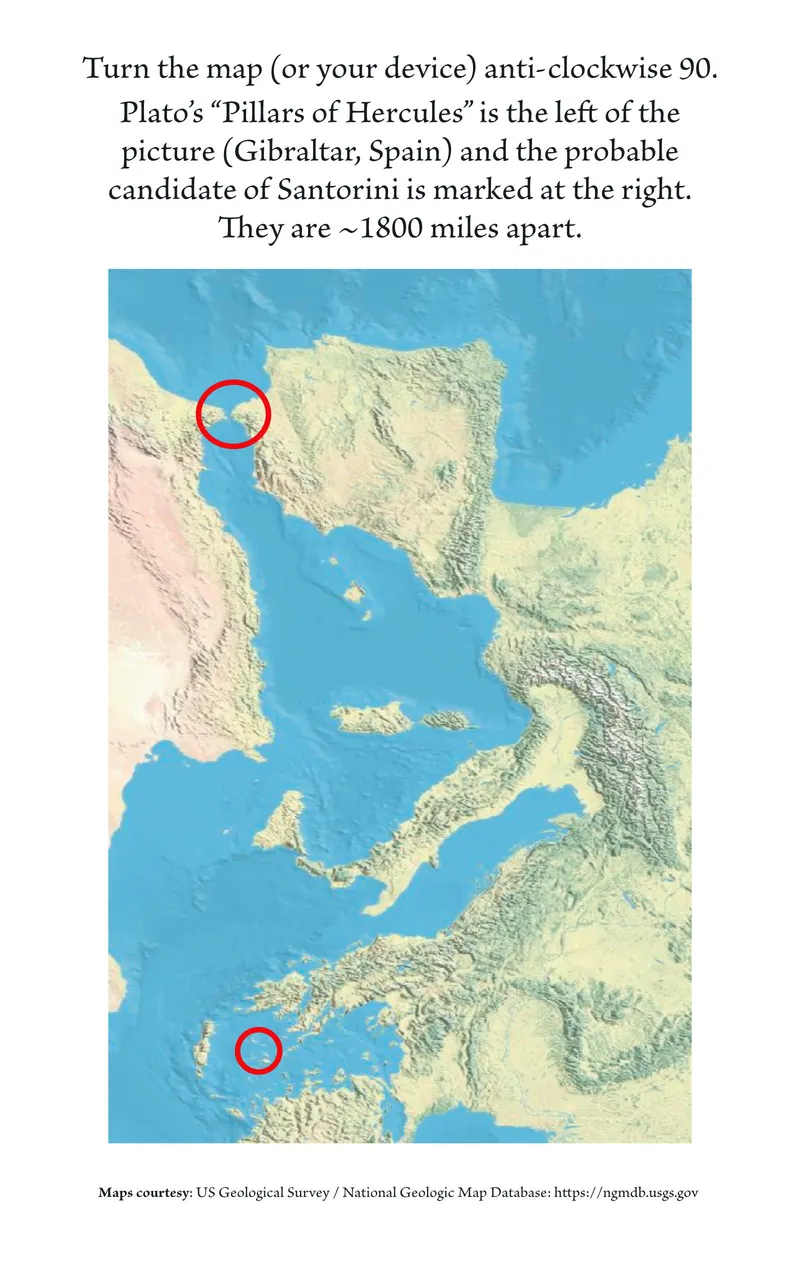
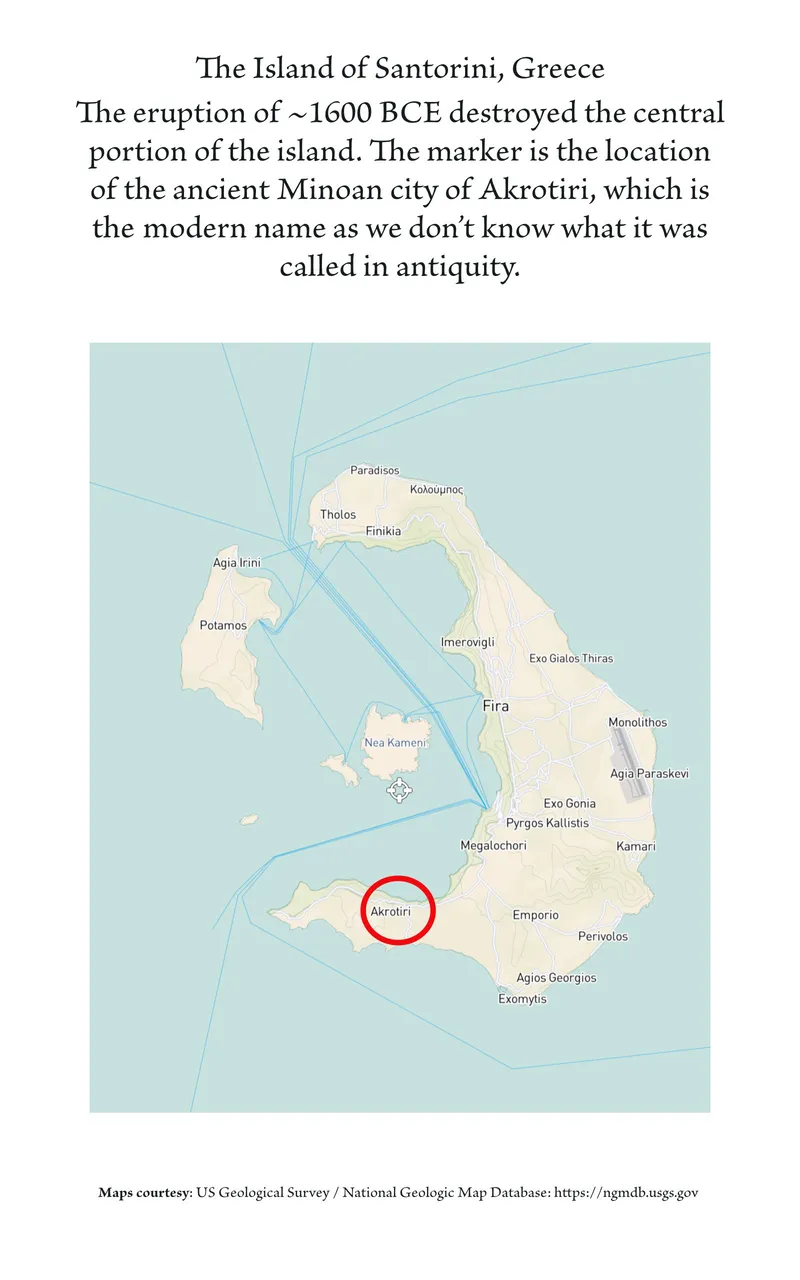
But then, go back to a world thousands of years ago, and it’s very likely that whoever knew of the original story was probably not an expert at geography either, or Plato deliberately changed it for whatever reason to suit his narrative. Atlantic? Mediterranean? A bunch of seas? Pfft—all the same.
What about other plausible locations? I won’t get into that here, but while other sites have been proposed, none come close to the story of Thera, so we’ll stick with that.
Sometimes, people on social media tend to take old sources literally and often exaggerate the usage of the word ‘advanced.’ This word, in context, means advanced for their time period, not advanced compared to us.
As we wind down this question of whether Atlantis really existed, let’s ask a few more questions about the original story of Atlantis, if it existed 11,000 years ago and was a major empire.
Didn’t the Atlanteans Toot their Horns?
Which brings us to… how is it that this “advanced civilization” never left any mark outside its island?
I mean, even the simple folks of Göbekli Tepe left some evidence, and Atlantis was supposed to be a major empire getting ready to take on all of Asia and Europe! Where are the settlement cities? Or shipwrecks? Or someone else yelling about them (like the Egyptians, for example)? If they were so great, surely they’d want to blow their trumpets (or more like carve on stone) about their greatness. They surely weren’t so humble, because they apparently subdued Libya (which, during Plato’s time, meant most of Africa west of Egypt) and planned to wage war on Europe and Asia.
From the many “Atlantis exists” documentaries and articles, it seems all they left are mysterious, barely decipherable “circular rings” to “hint” at their origins or memories. But why memories? You’re such an advanced civilization; surely you knew enough to, you know, leave some big granite monuments screaming your name!
Did Atlantis exist? There’s no credible evidence of a civilization called Atlantis in 9000 BC. But were there sophisticated people before Plato’s time who got into trouble? Sure — the Minoan civilization is a compelling candidate. Could someone, someday in the future, find a lost sunken city with spectacular circular harbors? One never knows.
But for now, the best thing about Atlantis is all the job opportunities it has created for authors (including me), movie makers, documentarians, divers, archaeologists, historians, influencers, Facebook group creators, tour guides, hotels… an entire industry.
Thanks, Plato.
To buy this in book format: here | For sources and acknowledgments see here.
Whispers of Atlantis ● Book 4 of 7 ● Also in paperback
Lost cities. Buried armies. Ancient secrets. Seven thrilling tales where fact meets fiction.
The Wrath of God ★★★★★
When the fires die, one great kingdom will remain standing.
When the earth trembles and fire erupts, the Oracle of the Atalanni demands conquest—and a young general sent against a formidable Pharaoh is about to learn that nothing is as it seems: duty clashes with morality, piety masks treachery, and a great secret lurks behind the fate of kingdoms.























About the Author
Jay Penner's highly-rated books regularly feature Amazon's category bestseller lists. Try his Spartacus, Cleopatra, Whispers of Atlantis, Hannibal or Dark Shadows books.