Did Alexander the Great Conquer India?
Let's have a good argument!
327 - 325 BC, India
“Alexander conquered India!” Jay yelled, then got into a flaming match with a lot of upset people. But who’s right? What did he conquer? As usual, let’s look at what we know because, unlike some other issues, we have compelling literature on “what went down” with Alexander.
First, a little bit of history and geography, because that’s kind of important if we want to talk about anything being “conquered.”
The Geography of His Conquest
Alexander set out on his conquest of Persia sometime in 334 BC. He didn’t stop there. He traveled further east, first heading north toward modern Afghanistan, Uzbekistan, and Tajikistan, before turning south for his desired next destination—India—in 327 BC.
He arrived by the Indus River sometime in 326 BC. At this time, the western world knew almost nothing about India. The only literature they had was written by the Greek historian Herodotus back in 440 BC. But Herodotus made some fantastical claims of giant ants and whatnot, so no one really understood much about the people or their customs. Generally, at this time, most of the land to the east of the Indus River fell into the broad category of India.
Remember, the Indians didn’t call their land India—the name comes from Greek writers based on the word Indus, which is a western version of the river’s ethnic name, “Sindhu.” The Indian subcontinent itself had many kingdoms, such as Magadha and Kalinga in the North, and Chola and Chera in the South, among others. Today, the Indus River flows through India and mostly modern Pakistan.
Our most definitive source for Alexander’s Indian conquest is Arrian’s Anabasis of Alexander. Writing sometime in the 2nd century AD, Arrian, the Greek historian and writer, used older works from Ptolemy (yes, the same Ptolemy who was Cleopatra’s forefather and a general of Alexander, thus having firsthand accounts of the invasion) and Aristobulus for his accounts. Other available sources for the campaign are Plutarch and Diodorus.
Based on these sources, we learn that Alexander arrived by the Indus in 326 BC to prepare for his conquest eastward. His first major battle was with the Indian king Porus by the banks of the Hydaspes River (modern Jhelum, which flows through Indian Kashmir and eastern Pakistan). Alexander defeated the Indian king, but seeing the gallant resistance he put up, he apparently returned all his territories as long as Porus acquiesced to Alexander’s rule.
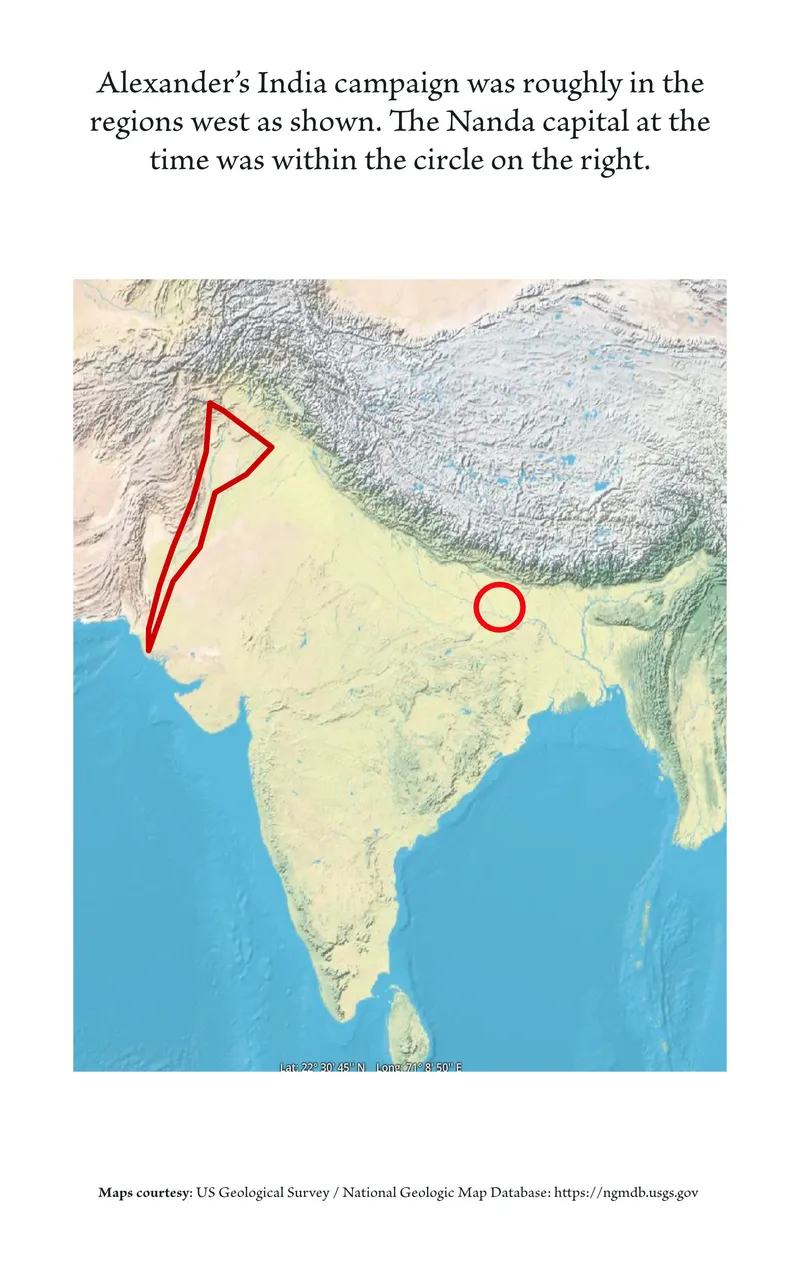
He then marched further east, arriving by the Hyphasis (modern Beas, which flows through the Punjab and Himachal regions of India) River. By this time Alexander had penetrated Indian territory, having come further east from the Indus — though geographically, he was still in the western periphery of India, as you can see in the map below.
But the soldiers were fed up. They had spent over a decade fighting, and they were exhausted. India’s climate made everything worse for them. The torrential rains, unfamiliar territory, many afflictions and diseases, heat and humidity, challenging terrain and logistics, combined with surprisingly sharp resistance, fear of elephants, and the stress of “great armies of the Indian king,” finally drove them to mutiny.
They refused to march further eastward. Finally, sensing the futility of the endeavor, Alexander abandoned his mission and turned back. He returned to the Indus River sometime in 325 BC and then sailed south. Along the way, he subjugated several small tribes and provinces, almost got killed during an attack on the “Mallians” (probably modern Multan), and finally exited the eastern frontier around 324 BC to return to Babylon. He died in Babylon in 323 BC at just 32 years old, having conquered the powerful Persian Empire and made his way to an unknown frontier. No matter what our modern sensibilities are regarding him, it is hard to ignore the astonishing achievement.
Now, geographically speaking, he made an incision to the northwestern edges of India and then left. Is that “conquering India”? He had not taken on the real empires that existed in India then—the Nandas, who ruled significant parts of Northern India, Kalingas in the east, or the Cholas and Cheras who ruled Southern India. Having said that, there is no question that Alexander’s expedition to India was a stupendous feat.
What Indian Sources Say
But what about Indian sources? Surely if he “conquered” India, there would be some remnants of the story?
This is where it gets really interesting and puzzling. There is no record of Alexander’s conquest in any Indian historical sources. It doesn’t mean they didn’t exist, but whatever was there has been lost to time — nothing of his presence is indicated even by oral traditions.
Soon after Alexander left India, a young man named Chandragupta Maurya took the reins after deposing the hated Nanda king. Megasthenes, a historian who went to the Maurya court, wrote that Chandragupta, as a boy, met Alexander. Indian sources say this emperor came to power with the help of a man named Kautilya, who wrote a famous treatise on politics, spycraft, and administration. Part of this book, Arthashastra, survives to this day. However, this treatise mentions nothing at all about Alexander.
What about any inscriptions? The earliest available written inscriptions in India date to around 260 BC, during Emperor Ashoka’s time. Ashoka was Chandragupta Maurya’s grandson. Ashoka established a remarkable set of rock edicts all over modern India and parts of modern Afghanistan (which were under Mauryan rule for a period). These edicts also make no mention of Alexander or his campaigns.
So why is there nothing on the Indian side? We have to put ourselves in that ancient world. There was no Twitter/X with “OMG Alexander is near our borders!” News traveled slowly — or not at all. Alexander’s final frontier by the Beas River was still nearly 700 miles away from the Nanda capital of Pataliputra in eastern India. An ancient army would need more than a year to get that far.
Imagine you’re a resident in London, and a foreign army is at the edges of Rome; you probably don’t care too much. As far as most Indians were concerned, he was a blip somewhere and left — assuming they even heard of him at all — and it simply didn’t leave an impression because he didn’t quite fight their biggest kings. It’s very possible that some people wrote about this, but all that literature has been lost to time.
But Alexander did leave behind a lasting influence. We know from later stone inscriptions that there were Greek administrators under Indian rule.
Ashoka, in his Rock Edict #13, specifically says,
“Here in [my] domain are the Greeks…”
And here’s an excerpt from the Junagadh (in the modern western Indian state of Gujarat) Rock Inscription of Rudradaman, written in the Brahmi script but using Sanskrit, circa 150 AD (about 450 years after Chandragupta). The inscription is about building a dam.
…for the sake of […] ordered to be made by the Vaishya Pushyagupta, the provincial governor of the Maurya king Chandragupta; adorned with conduits for Ashoka the Maurya by the Yavana king Tushaspha while governing; and by the conduit ordered to be made by him,…
The Yavana king in this case refers to a Greek (or Greco-Bactrian) governor named Tushaspha. Yavana was the Indianized version of Ionians, which is how the ancient Indians referred to the Greeks. It appears this Tushaspha governed under Ashoka’s rule. Don’t spend too much time looking for Tushaspha because, unfortunately, we know nothing more of him except in the Rudradaman inscription.
But it’s not a stretch to imagine that after Alexander left India, many Greek veterans, including those who may have governed sections around the Indus, chose to stay under Indian rule as the Mauryas took over from Seleucus. Greek art and architecture made their way to that part of the subcontinent, as evidenced by depictions of Buddha, known as Gandhara art. The Kushans, notably under Kanishka the Great (~125 AD), mixed Indian and Greek customs. You can see this influence by looking at Buddhist architecture all the way into Afghanistan.
While Seleucus made no dent in modern Indian consciousness, Alexander has. The word “Sikandar,” a form of the Persian “Iskander” for “Alexander (Al-Sikandar or Al-Iskander),” is part of the Hindi language. It means “king” or “emperor.” There’s even a very popular Hindi song that goes, “Yahan ke hum Sikandar,” which means “we are the kings here!”
That’s the story of Alexander and India. Not quite “conquered India,” but a “conquest of India” where he acquired a slice that his successor lost to the Mauryas a few years later. But Alexander left behind a lasting influence, bringing the west much closer to the east.
Now, what might have happened had the soldiers not mutinied and Alexander continued?
Our Facebook friends are gearing up for another internet fight, but we’ll leave them at that.
To buy this in book format: here | For sources and acknowledgments see here.

Whispers of Atlantis ● Book 1 of 7 ● Also in paperback
Lost cities. Buried armies. Ancient secrets. Seven thrilling tales where fact meets fiction.
The Atlantis Papyrus ★★★★★
A stolen scroll. A thousand-year-old secret. An impossible choice.
When Captain Deon accepts a forbidden quest to steal scrolls from Alexander the Great's sarcophagus and save his family from the mines, little does he know the mission is a lie—and a stunning ancient secret will force him to choose between his kin and a million lives. GRAB THE LIMITED TIME DEAL!














About the Author
Jay Penner's highly-rated books regularly feature Amazon's category bestseller lists. Try his Spartacus, Cleopatra, Whispers of Atlantis, Hannibal or Dark Shadows books.