July 17, 2026
A tale of a cheeky vandal
July 18, 2026
Hello, my dear readers,
Time for some interesting history!
I provide sources at the end.
Time for some amusing and hopefully interesting history. In February 2026, two scholars—Charlotte Schmid of the French School of Asian Studies in Paris and Ingo Strauch of the University of Lausanne—presented a paper at the International Conference on Tamil Epigraphy in Chennai. It's fresh research, published so far only in the conference proceedings, but it's on a pretty solid foundation for us to think it's genuine.
What Schmid and Strauch did was go back to the more than 2,000 graffiti recorded in the Valley of the Kings by the French scholar Jules Baillet, all the way back in 1926, and isolate those they believed to be of non-Greek origin. They found close to thirty inscriptions across six tombs, left by visitors from the Indian subcontinent between roughly the 1st and 3rd centuries CE—about twenty in Tamil-Brahmi, the earliest script used to write Tamil, and the rest in Prakrit, Sanskrit, and Gandhari-Kharosthi. And among these they found a wonderful example.
A man from 4,000 miles away
This was a man from far away. Like 4,000 miles away, from quite certainly Southern India, and a visitor to the Egyptian tombs. His name was Cikai Korran. Now, it appears he really took a liking to what his Greek and near-Egypt friends did. And that was some quality vandalism. There is no doubt that this man was amazed by Egypt's incredible tombs which, even by his time, were already over a thousand years old. And so, like all the other scoundrels before him, he decided to leave his mark so his name became immortalized like the kings within the tombs.
In eight places, no less (surely there were more, we just know of eight), across five tombs—one of them the tomb of Ramesses VI—he left his signature.
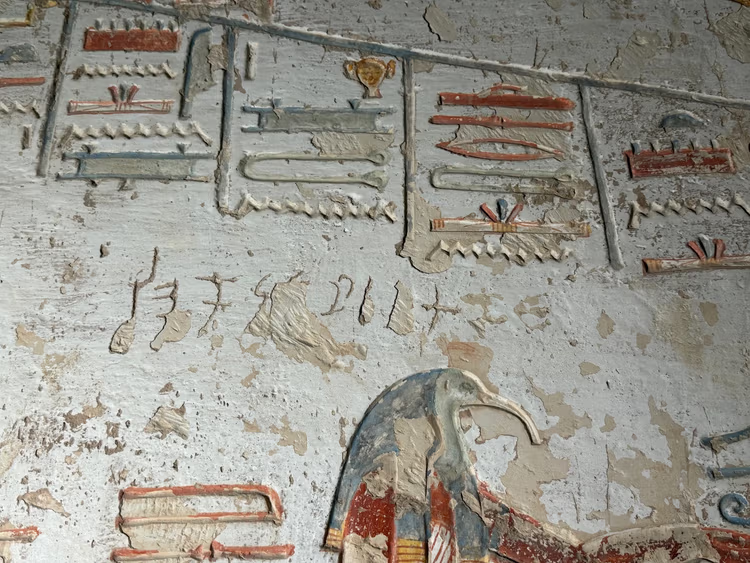 Source: The Art Newspaper
A fellow Tamil visitor, one Kopān, went a step further and used the same formula the Greeks scratched all over these walls:
"Kopān varata kantan," translated as "Kopān came and saw."
These words are not some laborious interpretation from antiquity—they're recognizably the words spoken by the people of Tamil Nadu in India today. I did some light research, and yes, forms of "vara" still mean "came" and "kanta" means "saw," even now. And to further confirm it, it turns out the neighboring state of Karnataka, whose language Kannada shares many Dravidian roots, has the same variation, where "banda" means came and "kanda" means saw. And these words are pretty much part of everyday language even today. Fascinating.
Korran's name itself tells a story. Schmid notes that "korran" derives from a root meaning victory, echoed in Korravai, the Tamil warrior goddess. The name even shows up elsewhere in Egypt—a "Korrapuman" was found inscribed on pottery at the Red Sea port of Berenike back in 1995—and in the ancient Sangam literature, which mentions a Chera king named Pittankorran. Graffiti in a pharaoh's tomb, a potsherd at a port, and classical Tamil poetry, all agreeing with each other. That's what makes this reading credible rather than wishful.
He wrote using the Tamil-Brahmi script. Brahmi is the ancient Indian script best known from emperor Ashoka's inscriptions of the 3rd century BCE, which were written mostly in Prakrit, and it's the ancestor of nearly every script in South and Southeast Asia today. Tamil-Brahmi is its southern adaptation, with extra characters added for Tamil sounds.
Why should we care about a scribbler?
But okay, what's so special about another graffiti-scribbling errant tourist? He probably did what many Greeks and Romans in Egypt did anyway. Well, a few things. One, he was from a very far part of the world, and there are simply not many examples of Indian visitors (there are some). Second, this is the first solid proof of Indians traveling deep inland in Egypt, rather than staying at the coastal ports like Berenike on the Red Sea or Alexandria. As one Egyptologist put it, until now there was no "solid proof of visitors from India to the Nile Valley" this early. And not all of them were traders—one Sanskrit inscription was left by a man named Indranandin, who called himself a messenger of King Kshaharata, a 1st-century CE Indian dynasty. An ancient diplomat, possibly on his way to Rome, sightseeing en route. Some things never change.
It also highlights the sheer scale of trade between Roman Egypt and India. The geographer Strabo tells us that by the time of Augustus, as many as 120 ships sailed for India every year from a single Red Sea port. And Pliny the Elder grumbled about it—the ancient equivalent of complaining about the trade deficit:
"And by the lowest reckoning India, China and the Arabian peninsula take from our empire 100 million sesterces every year—that is the sum which our luxuries and our women cost us; for what fraction of these imports, I ask you, now goes to the gods or to the powers of the lower world?"
Those darned women!!
Did he go to emperor Vespasian and seek that he impose tariffs? Tariffs I say! Well, we don't know. One surviving papyrus values a single ship's cargo from the South Indian port of Muziris at nearly seven million sesterces, of which Rome took a quarter in import duty. This was serious money.
And here's a connection I love. Writing over a century after the events, Plutarch tells us that after Cleopatra and Antony's defeat, she tried to send her son far beyond Rome's reach:
"Caesarion, who was said to be Cleopatra's son by Julius Caesar, was sent by his mother, with much treasure, into India, by way of Ethiopia." — Plutarch, Life of Antony
But the boy was persuaded to turn back by a treacherous tutor, and eventually murdered on Octavian's orders. For Cleopatra to send her son to India (which made sense, because India was far outside Roman influence) suggested a certain familiarity with the region and her confidence that he would find the right sanctuary. The escape route she chose and the road our vandal took were two ends of the same well-trodden corridor. Come to think of it, if Caesarion had actually made it, and his lineage survived, a bunch of Indians would be Caesar and Cleopatra's descendants! Well, guess that was not to be. I digress.
A ladder, or a friend's shoulders?
There's something more amusing about this guy. Several of his graffiti were placed high on the walls—one about four metres up at a tomb entrance—which suggests one of two things: either he went around with a ladder, or he was in the company of sniggering buddies, all probably cackling away with joy as they hoisted him on their shoulders so he could conduct his mischief. We will never know. But what he did now leaves us with fascinating evidence of ancient trade and people's travels.
Who was Cikai Korran? I like to imagine his life, probably under a Chera king. How did he end up in Egypt? Where did he meet European merchants? What route did he take, and what did he see? Did he ever return home to share all the wondrous things he saw? Did he tell the Greeks and Romans all about his home?
There is plenty of graffiti in Pompeii too, but what caught my eye about this one was that it came from a distant visitor from an entirely different culture, and there he was, doing the universal thing.
Misbehaving as a tourist.
Lucky Tik Tok, YouTube, and X weren't around then. He'd be crucified.
- Jay
Sources
- Report from the International Conference on Tamil Epigraphy, Chennai, February 2026
- The Art Newspaper — 2,000-year-old inscriptions found in Valley of the Kings — with quotes from Schmid, Strauch, and an independent Egyptologist
- Plutarch, Life of Antony 81–82 — Caesarion sent toward India via Ethiopia, then lured back and killed
- Pliny the Elder, Natural History — the hundred-million-sesterces complaint (Book 12, §84; see also Book 6 on the voyages to India)
- Language Log (Victor Mair) on the Indian inscriptions