Did Aliens Build the Pyramids?
Apparently the builders can't catch a break
2580 - 2560 BC, Egypt
“There is simply no way Khufu and his ilk built the Pyramids. Look at them!” Jay exclaimed, waving his iPhone. “Perfectly aligned rocks point to Orion as it looked in the sky thousands of years ago. Even we wouldn’t be able to do it. Surely, it is the work of a lost civilization!”
This one is the mother of all ancient-world conspiracies.
Of all the many interesting theories about our ancient past, the one that probably gets posted the most is the notion that an ancient civilization built the Pyramids because, at first glance, it seems impossible for the people of that time (i.e., the ancient Egyptians who lived in 2500 BC) to build them.
But our job here is not to scoff at the skeptics but to walk through what we know and try to draw a conclusion.
First, a few facts about the Great Pyramid of Giza, because that’s the one most in controversy and the largest and most impressive.
Some facts about the Great Pyramid of Giza
This is what historians, scholars, builders, and architects tell us.
Built by Egypt’s fourth dynasty between 2580 and 2560 BC, this structure served as a tomb for Pharaoh Khufu (also known as Cheops). Khufu’s vision for an eternal resting place probably took around 20 years to realize. A workforce, not as massive as once believed (100,000 according to Herodotus, writing in the 400 BC time period), likely numbered between 20,000 and 30,000 people, undertaking the colossal task. This team included skilled laborers, support staff, and conscripts, all contributing to the pyramid’s construction.
Originally, the pyramid reached a height of about 146.6 meters (481 feet). Although it has lost some height over millennia due to erosion and the removal of outer casing stones, it still stands at about 138.8 meters (455 feet) today. The entire structure weighs an estimated 5.9 million tonnes and comprises roughly 2.3 million blocks of limestone and granite, with each stone block averaging 2.5 tonnes. Some blocks used in the structure weigh up to 80 tonnes.
The pyramid’s base covers an expansive 13 acres (approximately 5.3 hectares), with each side once measuring about 230.4 meters (756 feet). The builders aligned the pyramid’s sides almost perfectly with the four cardinal points—north, south, east, and west—showcasing their precise engineering skills (and this is one of the contention points on how the ancient people could’ve possibly done it without advanced technology—but we’ll get to that).
Inside, the pyramid houses three main chambers: the King’s Chamber, the Queen’s Chamber, and an unfinished subterranean chamber. The King’s Chamber features a granite sarcophagus and is entirely constructed from large granite blocks. Leading up to the King’s Chamber is the Grand Gallery, a sloping corridor known for its corbelled arch ceiling.
The Great Pyramid wasn’t just a tomb; it symbolized Pharaoh Khufu’s absolute power and divine connection. It’s the only surviving structure of the original Seven Wonders of the Ancient World. No question remains that it is one of the most captivating structures from the ancient world and possibly the most impressive one.
But yeah, did an ancient advanced lost civilization build it, rather than the fourth dynasty?
Let’s tackle this from three angles, starting by believing that an advanced lost civilization actually built it.
- What specific other evidence did this ancient civilization leave to show that it was they who built it? Say, literature? Other monuments that look totally advanced and different from what the Egyptians built? Carvings? Fancy graves and skeletons? Spaceships?
- What specific evidence do we have that the Egyptians themselves built it?
- Are some of the things people claim as impossible for the Egyptians really impossible?
Evidence It Was Built by an “Unknown” Civilization
Surely an advanced ancient civilization would’ve done more to leave their imprint?
Like many other “advanced” theories, like Atlantis, for whatever reason, it seems these ancient folks liked to build very impressive stuff but leave nothing to suggest it was them. Remember our Atlantis story? For all the impressive things those guys did, all they left behind apparently was some concentric circle symbols.
There is no evidence of any kind to support the existence of an older, different civilization by way of literature (none), other equally monumental and befuddling structures (none), someone else stating that it was built by a different people (none), Egyptians themselves recording that mysterious ancient people built them (none), or some other civilization, say the Sumerians, alluding to an ancient people (none).
We’re therefore left with nothing but just a belief based on the theory that the engineering challenges the Pyramid poses could’ve been impossible for the Egyptians to solve. But before we go there, let’s look at what we have that supports the idea that the Egyptians built it.
Evidence It Was Built by Ancient Egyptians
What should we look at to support the hypothesis that the Egyptians themselves built the Pyramids? Well, we should take the scientific approach. We are talking about a world and event (Pyramid building) that took place nearly 4,500 years ago. We’re not going to find a video documentary (EBC Presents, ‘King Khufu and his Pyramid’), an autobiography (‘Hemiunu: How I Built the Great Pyramid, Edition 2, Updated with Maps!’), a podcast (‘Joe Ahmose Presents How My Advice Was Ignored Featuring Neferu, Former Architect at the Court’), or a movie (‘The Stone Singer—a thriller featuring mega star Ramesses’). We have to cobble together archaeological artifacts—and we can group them in some logical way.
From the period:
- Carvings/hieroglyphs or papyrus
- Workmen’s quarters, graveyards
- Contemporary accounts
- Evidence of construction (quarries, ramps, tools)
- Surrounding/deducible evidence (similar structures, evolution of such structures…)
From later periods:
- Historical records from the ancient period
- References to Pyramids in later literature or construction
- Acknowledgment of who built it by later people
And as we look at each, we should also keep asking ourselves: does any of this point to another people (an older unknown civilization or aliens)?
Let’s go because this is such a fascinating event, and it’s full of interesting facts.
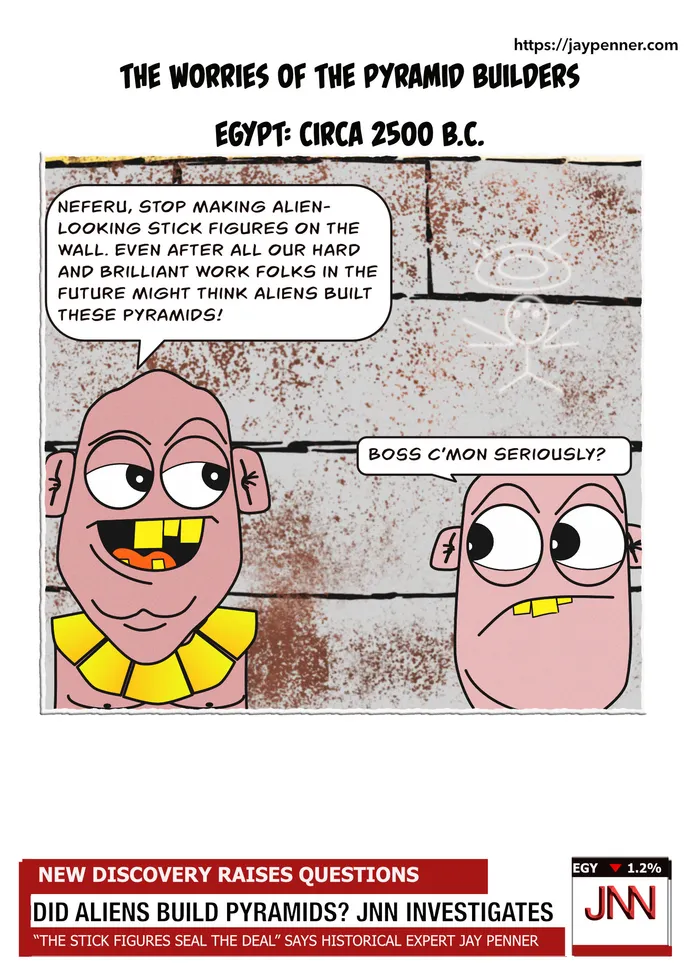
Contemporary Carvings/Hieroglyphs or Papyrus
Inscriptions found in the hidden chambers of the Great Pyramid, such as the relieving chambers above the King’s Chamber, include hieroglyphs and marks like “gang marks” left by the workers. One notable inscription discovered by Colonel Howard Vyse in the 1830s mentions “The Friends of Khufu Gang,” directly linking the workforce to Pharaoh Khufu. Graffiti by workmen, as old as time.
Additionally, the papyri discovered at the ancient harbor of Wadi al-Jarf in 2013, often called the Diary of Merer, provides detailed accounts by an overseer named Merer, describing the transportation of limestone blocks from the Tura quarries to Giza, mentioning Khufu repeatedly.
Workmen’s Quarters, Graveyards
Excavations led by archaeologist Mark Lehner uncovered workmen’s quarters at the Giza plateau. These extensive quarters, located south of the Great Pyramid, included long barracks houses, bakeries, and breweries, indicating organized labor housing.
You can see them on Google maps too. Nearby, the “Workers’ Cemetery” revealed burial sites containing skeletal remains of laborers, which included healed fractures and evidence of heavy labor. These finds suggest a substantial, well-managed workforce. The nature of these quarters and burials was also consistent with similar ones elsewhere from that period (~2500 BC), suggesting that regular, everyday Egyptians of the time built the Pyramid, rather than an unknown foreign people.
Lehner also found evidence of a massive inland harbor and port, indicative of the use of water transport. And just recently, we’ve found clear evidence of a lost Nile tributary that flowed very close to the Pyramids, further bolstering the idea that they used water for heavy transport.
Contemporary Accounts
While there are no direct written records from Khufu’s time explicitly detailing the construction of the Great Pyramid, administrative records and inscriptions from the Old Kingdom period, such as those found in tombs of high officials like vizier Ankhaf and overseer of works Hemiunu, refer to large-scale construction projects under Khufu. The Wadi al-Jarf Papyri (made sometime around the 27th year of Pharaoh Khufu’s rule) provide indirect evidence through logistical reports contemporary to the pyramid’s building phase.
Evidence of Construction (Quarries, Ramps, Tools)
Major archaeological findings include the limestone quarries at Tura and red granite quarries at Aswan, both used for the pyramid’s construction. Archaeologists found remnants of copper tools, such as chisels and saws, in the ruins and quarries. The discovery of large ramps at the quarry sites and remnants of sledges near the Giza plateau supports theories about the methods used to move and lift the massive stones.
Additionally, experimental archaeology has reconstructed these methods, confirming their feasibility. We’ll go over some of the major challenges people often consider “impossible for them” and see how we figured it was indeed quite possible.
Surrounding/Deducible Evidence (Similar Structures, Evolution of Such Structures)
The pyramids at Giza, including those of Pharaohs Khafre and Menkaure, alongside earlier pyramids like Djoser’s Step Pyramid at Saqqara, show a clear progression in architectural techniques.
Khufu’s pyramid, being the largest, represents the apex of pyramid construction. The mastaba tombs and smaller pyramids of the Fourth Dynasty officials around Giza also provide context, showing a sustained effort and advancements in construction techniques. These related structures indicate a well-practiced state-organized system for achieving large-scale building projects. This is an important element. The Great Pyramid didn’t rise majestically out of a mad genius’s architectural dream or some other unexplained phenomenon. We’ll talk about it soon, but there may have already been centuries of experimentation before the Great Pyramid came to life.
Now that we’ve covered critical aspects from the Pyramid period, if we ignore all of that, perhaps later ancient writers knew the “hidden truth.” What did they say?
Let’s see.
Ancient Writers about the Pyramids
Herodotus, our favorite ancient historian, visited Egypt sometime around 450 BC, saw the Pyramids, and gathered material from oral traditions. In his “Histories,” Herodotus attributes the construction of the Great Pyramid to Pharaoh Cheops (the Greek name for Khufu). He describes how Cheops employed a large workforce and details the methods and duration of the construction. So, as far as Herodotus was concerned and what he heard, it was Khufu and his fine folks who made the Pyramids. He also mentions the use of a vast labor force, reportedly 100,000 men rotating every three months, and talks about how they transported the stones and constructed ramps (modern scholars think it was probably 20,000 to 30,000 laborers rotating over 20 to 30 years). But that was a summary; let’s actually look at what Herodotus said in his Histories:
…The pyramid itself was twenty years in building. It is a square, eight hundred feet each way, and the height the same, built entirely of polished stone, fitted together with the utmost care. The stones of which it is composed are none of them less than thirty feet in length.
Herodotus goes on to attribute the building to Cheops (Khufu) and the other two Pyramids to Khafre and Menkaure.
A side note: Rulers and politicians embarking on massive construction projects to calm a restive population or spur growth is nothing new. Whether Khufu’s intention was completely megalomaniacal or whether he cleverly figured out that keeping people employed with a purpose was good governance and led to peace is not known, but we have a very modern equivalent (not the megalomaniacal part). Back in 1956, US President Dwight Eisenhower signed the National Interstate and Defense Highways Act, paving the way for America’s incredible freeway system. The reason for the act was both improving logistics across a vast country and easing military (and civilian) transport, and also spurring economic growth. The massive building program, spanning 41,000 miles (65,600 kilometers), transformed the US.
Anyway, let’s get off I-5 and return to the Pyramids!
Manetho, an Egyptian priest writing in the 3rd century BC, compiled a history of Egypt called “Aegyptiaca.” Although the original work is lost, excerpts were preserved by later historians like Josephus and Eusebius. Manetho attributes the construction of the Great Pyramid to King Suphis (another name for Khufu), supporting earlier and contemporary accounts. Just so you know, Manetho’s king list is one of the definitive sources for the list of Egyptian Pharaohs.
In the 1st century BC, Diodorus Siculus, another Greek historian, wrote about the pyramids in his “Bibliotheca historica.” He also attributed the Great Pyramid to Cheops (Khufu) and provided descriptions based on his observations and information from local sources.
Our other popular figure, the Greek geographer Strabo, writing at the end of the 1st century BC, visited Egypt and described the Great Pyramid in his work “Geography.” He provided observations of the pyramids’ structure and noted their state of preservation. Here’s a short excerpt of what he says:
On proceeding forty stadia from the city, one comes to a kind of mountain-brow; on it are numerous pyramids, the tombs of kings, of which three are noteworthy; and two of these are even numbered among the Seven Wonders of the World, for they are a stadium in height, are quadrangular in shape, and their height is a little greater than the length of each of the sides; and one of them is only a little larger than the other…
Strabo clearly mentions that these were tombs of kings and does not say anything about anyone else building them.
In his work “Natural History” (circa 77-79 AD, Book 36, Chapter 17), Pliny the Elder mentions the pyramids and attributes them to the kings. He provides general descriptions and marvels at the construction feat, emphasizing that the ancient Egyptians built it, further reinforcing historical memory. Here’s something that’ll blow your mind: Pliny is closer to us than the Pyramids were to him!
There are other acknowledgments too, but it’s worth noting that all ancient sources attributed the Egyptians with building the Pyramids. The ancient unknown civilization and aliens entered the arena only after… well, Facebook became popular.
But it’s wise to acknowledge that the earliest European account of the Pyramids came almost two thousand years after they were built! Imagine that: the Pyramids were older to Herodotus than Jesus is to us! For this reason, we must take Herodotus and other ancient accounts with a grain of salt because he was known to exaggerate details, and his accounts were sometimes hearsay or based on oral traditions that changed over time. Even if Herodotus went to see the Pyramids, it’s reasonable to say that modern archaeologists and historians have a better understanding of the circumstances surrounding the Pyramids than he did. We can stitch together many more evidentiary artifacts through the use of tools, science, and geographical coverage than Herodotus could ever do.
Now that we’ve looked at both contemporaneous records and later accounts, which all seem to point out that Egyptians built the Pyramids, let’s examine the objections regarding how they possibly did that.
Could the Egyptians really have built the Pyramids?
These objections can be grouped into five areas.
-
They couldn’t have transported the heavy 30- to 80-ton stones and positioned them with such precision, with no gaps between them, and erected a structure to such height.
-
They couldn’t have situated the Pyramid on hilly land but leveled it with such incredible accuracy.
-
They didn’t write about it.
-
Other similar pyramid-like structures around the world hint at something grander.
-
The astronomical alignments of the Pyramids were impossible for “normal” Egyptians or don’t align with their time.
Let’s examine each one, but before that, a quick note on the construction of the Pyramids. The Great Pyramid is not made of just one type of stone—there were essentially three types:
(1) Local limestone used for most of the blocks,
(2) Tura limestone (smoother quality), which acted as casing stones (the outer layer), and
(3) Granite for strength and aesthetic considerations, such as the sarcophagus, king’s chamber, and parts of major passageways.
In its pristine state, the Pyramid would have been an awe-inspiring sight, shining white in color (Tura whitestone) and capped by a gold capstone that would have glistened in the sun.
So, let’s now deal with the objections:
Cutting and Carving: The majority of the limestone blocks were quarried directly from the Giza plateau, located just south of the Great Pyramid. The fine white Tura limestone used for the outer casing of the Pyramid came from the Tura quarries, located about 13-15 kilometers (8-9 miles) south of Giza on the eastern bank of the Nile. This means they weren’t in some far corner of the country. The builders chose the location because of its proximity to building materials, which made a lot of sense. How did they cut and then move them? Studies have shown that cutting and carving limestone with normal copper chisels (found) and stone tools is perfectly possible. It’s also possible to cut granite using chisels, quartz sand abrasives, copper borers, and hard stone hammers (dolorite). You needed patience and time. Lots of time. Lotsa people and lotsa time, and Khufu had both.
Transportation: They moved granite on barges from the south (around Aswan) and then dragged it on sleds. We know that there was a harbor by the Pyramids, and the Egyptians, like all ancient cultures, heavily used waterways. It was the principal mode of goods transport. We’ve also found a wall relief in the temple of Pharaoh Hatshepsut (the Pharaoh was a she, a very impressive lady who lived around 1460 BC) that shows workers transporting a massive stone obelisk on barges, so we know they were used to doing this.
It’s possible that nearly 30,000 men worked on various building projects during the initial periods — meaning many workers per stone, taking days if needed. It was an endeavor of immense human effort, but very possible. To put the 30,000 figure into perspective, imagine Khufu calling for a workers’ parade. With 10 workers per row, the line would be nearly two miles long, and it would take him nearly 40 minutes to salute all of it. Another perspective is the modern Burj Khalifa — 5.7 times taller than the Pyramid, with about 12,000 workers at its peak, built in about 6 years. The Pyramid had nearly three times the workforce and three to five times as long to do something far simpler.
Placement: Herodotus mentions how the Egyptians used wooden sleds and machines to place the stones next to each other. They built ramps to move the stones and progressively piled them. What is extraordinary and still not entirely decoded is how they finished the upper portions and moved massive granite blocks, but there are theories of internal ramps. We don’t quite know yet, so we have to concede that they were ingenious and figured that out. Unfortunately, no literature describes how they did it.
Leveling: Much is made about how they couldn’t possibly have leveled the Pyramid with such incredible within-an-inch accuracy despite its massive base. Let’s do a simple exercise. You’re taken to a muddy, uneven field with workers, ropes, stakes, shovels, axes, picks, and a nearby canal. No modern tech. Task: cut a rectangle on the ground that’s perfectly even.
Here’s how you do it. Survey the area and mark the perimeter with ropes and stakes. Have workers dig trenches along the perimeter, moving soil from high spots to low areas. Dig channels and fill them with water from the canal. Water naturally settles, revealing uneven spots. Add or remove soil until the water level is consistent throughout. Tamp down the soil. Done — remarkable accuracy, basic tools.
What about the perfectly cut stones? They marked straight lines on stone using red ochre or ink, then used copper chisels, mallets, and sand-abrasive saws to cut along these lines. For vertical alignment, they employed plumb bobs (weighted stones tied to a string) and checked regularly with sighting rods and A-frames. Once a supervisor showed a worker how to do this a few times, a team of “measurers” and “cutters” could become experts. Bottom line? Very doable with the tools of the time.
So, let’s give a huge shout-out to gravity, water, and very clever civil engineers! It really doesn’t look like we need an ancient advanced civilization or “unknown” technology to pull this off.
Lack of Literature: Not many folks wrote or read back in 2500 BC. An exceedingly small fraction of the population — pretty much the Pharaoh’s scribes — were literate. Traditions were oral: people explained stuff, showed stuff, and repeated. There were no printing presses, and writing was too time-consuming and not scalable.
Even assuming there was copious literature, let’s not forget that it’s now been 4,500 years. Much of whatever had been written is lost to time — decay, reuse, destruction, name it. Despite the humongous amount of modern literature on ancient battles and wars, there’s actually very little ancient written information on how armies were organized or fought. Just because we haven’t seen a tome titled “This is How I Built the Pyramid” doesn’t mean they didn’t build it.
Now, let’s look at the final interesting counterpoint.
The “Pyramids on Other Continents” Theory
Another interesting and often repeated theory regarding evidence of an ancient civilization that dispensed knowledge is the existence of pyramidal structures around the world, such as the Mayan pyramids in South America, the Ziggurats of Mesopotamia, and the mounds in China. It is argued that the presence of these sophisticated massive structures is further evidence that they all received building knowledge from a previously unknown civilization.
Let’s consider this. For starters, those structures did not appear around the same time. The Great Pyramid of Giza was built around 2500 BC, the Ziggurat of Ur around 2100 BC, and Chichen Itza in Mexico was built around the 5th Century AD, almost 3,000 years after the Pyramids. It seems odd that a civilization no one can point out has been handing off these instructions over such a vast period without ever being found. The differences don’t stop there. The Egyptian Pyramids were essentially kings’ tombs. They were not temples and offered no ceremonial purpose. On the other hand, the Ziggurat and the Mexican Pyramids were for worship, with a temple on the top. The only thing that was really common among them was the general shape (they aren’t even exactly the same, but we’ll ignore that). Basically, the plans are not the same, the purposes are not the same, and the timelines are not the same.
Let’s tackle whether the Great Pyramid was the first. After all, for something so spectacular to be built by an ancient, lost advanced civilization, it should have just popped up, right? Well, it didn’t. We have archaeological evidence (you can even visit them) of pyramids built before the Great Pyramid.
Before the Great Pyramid of Giza was built, earlier pyramids were constructed during Egypt’s Third Dynasty, around 2670 to 2620 BC. One of the most significant of these is the Step Pyramid of Djoser, located in Saqqara. Designed by the architect Imhotep (we have his name on the pyramid, smart guy), it was built for Pharaoh Djoser. This pyramid started as a traditional mastaba but expanded into a six-stepped structure, reaching a height of about 62 meters (203 feet, a little less than half the height of the Great Pyramid). The Step Pyramid marked a major architectural innovation, transitioning from simple tombs to more complex pyramid structures.
Following the Step Pyramid, the Fourth Dynasty saw the construction of pyramids for Pharaoh Sneferu. He built the Bent Pyramid and the Red Pyramid at Dahshur around 2600 BC. The Bent Pyramid, named for its unique change in angle halfway up, was an experimental design. It reaches a height of about 104 meters (341 feet). Sneferu’s Red Pyramid, considered the first successful smooth-sided pyramid, stands about 105 meters (345 feet) tall. These developments culminated in the techniques and designs used for the Great Pyramid of Giza, constructed shortly after for Pharaoh Khufu.
Almost 150 years passed between Imhotep’s creation of the early, large prototype of a pyramid and the construction of the Great Pyramid, with many experiments and learning occurring in between. No doubt, methods passed through generations were refined, tested, and improved. I mention generations because the average life expectancy in ancient Egypt was about 40 years. That translates to about four generations. It doesn’t quite make sense that an advanced civilization would provide piecemeal information over nearly two centuries. Why not just give the Egyptians, you know, the grand plan for the Pyramid? All evidence shows an evolution in building techniques—just like what we see all around us. Look at the multi-storied buildings of the early 19th century and compare them to what we have now.
There’s another aspect about the shape of the Pyramid that seems mysterious; it “harnesses energy in the center,” and so on. Let’s do another mental exercise.
Now, is having a pyramidal shape such an unusual concept? Would the Egyptians (or others) need an older, lost civilization to bequeath them the idea of building a pyramid (assuming this older civilization didn’t construct it themselves but left no marks that it was them)?
Imagine you’ve taken a 6-year-old to the beach with plenty of sand. You tell them, “Build the tallest structure you can!” What shape would it be? Through iterations, even children realize that the best way to achieve height is by creating something with a broad base that tapers. For every foot of height, they’d understand they need to expand the base.
You know, like a mountain.
Mountains around us.
With their knowledge of foundations still rudimentary, the Egyptians, just like the Mesopotamians, would have recognized that if they wanted a tall, impressive structure, they needed a wide base. Through experimentation, they learned that stacking stones vertically for significant height was both challenging and required too much material. A pyramid provided an effective solution: it allowed for previously unreachable heights while requiring less material for each incremental foot! Like… mountains.
Similarly, other cultures, and there are many clever folks around the planet, existed thousands of years ago and realized that a pyramidal structure worked pretty well. It’s not just the Egyptians and Mesopotamians. Even the gopuram styles of old Indian temples taper and reach impressive heights. There’s a reason why no ancient tall structure is a cylinder or a cube.
The Orion Mystery (?) and the Astronomical Aspects
This theory suggests that the three main pyramids of Giza align with the three stars of Orion’s Belt (Alnitak, Alnilam, and Mintaka) with a precision that would not have been possible around 2500 BC due to the precession of the equinoxes—a gradual shift in the Earth’s rotational axis over a 26,000-year cycle. Instead, proponents claim the alignment would have been accurate around 10,500 BC, implying that the pyramids were built or planned then by a highly advanced civilization. However, this theory is controversial, as the alignment is not exact, depends on chosen vantage points, and disputes the impossibility of alignment in 2500 BC. Again, there is no archaeological evidence of an advanced civilization in Egypt around 10,500 BC capable of such feats. I’d say it’s pretty insulting to our forefathers to imagine they couldn’t align a building to a general direction of the stars!
But hold on!
Here’s a surprisingly interesting coincidence.
Angkor Wat, the world’s largest temple structure, built in the early 12th century by the Khmer king Suryavarman II to worship the Hindu God Vishnu, has a central tower that is approximately 65 meters tall. The Great Pyramid at Giza’s original height was approximately 146.6 meters. When you divide 146.6 by 65, you get 2.255. Here’s where it gets really interesting. Remember the ‘golden ratio’? It is a ratio (phi = ~1.618) that symbolizes aesthetic proportion and harmony and is used in ancient structures like the Parthenon in Athens, Greece. Now, did you know that 2.255 is actually very close to ((phi^2 + 1)/phi)? This amazing relation to the golden ratio is further proof that ancient people with advanced mathematical knowledge spread these concepts around the world.
Wait.
Not so fast.
If you’re wondering why you haven’t seen this theory, that’s because I completely made it up. Making mathematics work to your favor is pretty easy. It’s possible to conjure all kinds of coincidences and make them look like something amazing is being hidden by vested interests.
So please don’t share this on Facebook! All of it is conjured. But it’s another example of how easy it is to take some numbers, find relations, and then build a story behind it.
Go ahead, do a mental exercise. Take the number of letters in your name, multiply it by any popular ratio or constant, and you’ll find a relation to height, weight, direction, volume, span, perimeter, angle, position, or something else linked to the Great Pyramid. It doesn’t mean anything, though. Not until it is peer-reviewed, debated, argued, buttressed with archaeological evidence, and supported by sensible inferences.
Like the Mesopotamians and Indus Valley people, the Egyptians had a good understanding of the alignment and direction of stars. That understanding wouldn’t have developed over just a few years before the building of the Pyramids. Like all ancient people, they studied and pondered the stars in the electricity-less pitch black of the night and wondered about them for centuries, learning patterns over time. They figured out that stars made good anchor points, and because they were so mysterious and “godly,” they provided great reasons to align buildings or offer prayers. But yes, it’s definitely more boring than aliens descending in starships or a lost mysterious civilization doling out “knowledge.”
Whew. That was a lot. I do think we do a disservice to the remarkably clever and hardworking people of ancient Egypt by crediting “someone else” for their work.
The Greeks and Romans encountered an ancient civilization when they set foot in Egypt, and they marveled at what they saw. They borrowed ideas and gods, and when they wrote about Egypt, they attributed the works to no one else but the Egyptians.
What pains me more is the notion that all these brilliant people couldn’t have accomplished what they did without the help of some speculative “lost” savior civilization. Often, people attribute these ancient marvels to a single, spectacular act of construction in a narrow band of time. The truth is, they emerged after centuries — or even thousands of years — of prior experimentation and failure.
Let’s put this to the test
Finally, centuries of archaeological excavations by dedicated people from around the world, peer-reviewed research work, and scientific studies have all been consistent: the ancient Egyptians of the time of Pharaoh Khufu built the Pyramids. It was a monumental task that probably took twenty to thirty years, employing about twenty to thirty thousand people in rotations. They used the tools available at the time, utilizing bronze, copper, stone, quartz, sand, and water. It was a remarkable engineering feat for the time, driven by their remarkable will (and either a megalomaniacal king or a clever one, depending), perseverance, and some very smart and ingenious architects and builders who learned from advanced minds experimenting centuries before them.
Just because we don’t understand how they did it doesn’t mean they couldn’t do it or that aliens did it.
To buy this in book format: here | For sources and acknowledgments see here.
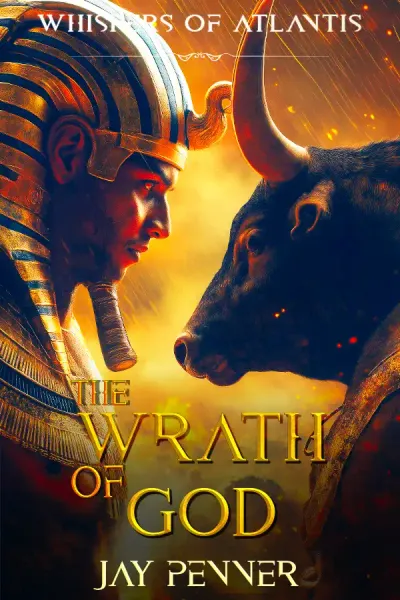

Whispers of Atlantis ● Book 4 of 7 ● Also in paperback
Lost cities. Buried armies. Ancient secrets. Seven thrilling tales where fact meets fiction.
The Wrath of God ★★★★★
When the fires die, one great kingdom will remain standing.
When the earth trembles and fire erupts, the Oracle of the Atalanni demands conquest—and a young general sent against a formidable Pharaoh is about to learn that nothing is as it seems: duty clashes with morality, piety masks treachery, and a great secret lurks behind the fate of kingdoms.































About the Author
Jay Penner's highly-rated books regularly feature Amazon's category bestseller lists. Try his Spartacus, Cleopatra, Whispers of Atlantis, Hannibal or Dark Shadows books.